


A Taxing Question (revised version)


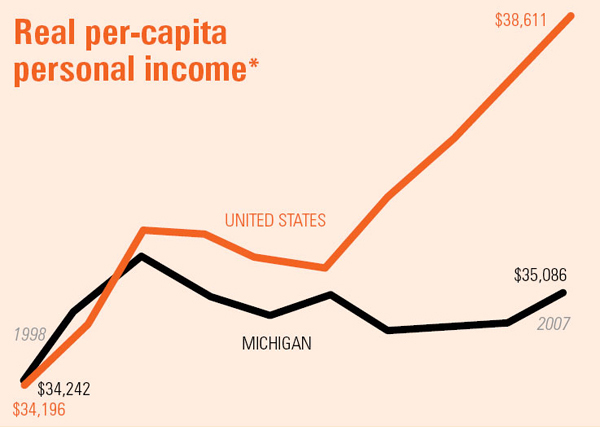
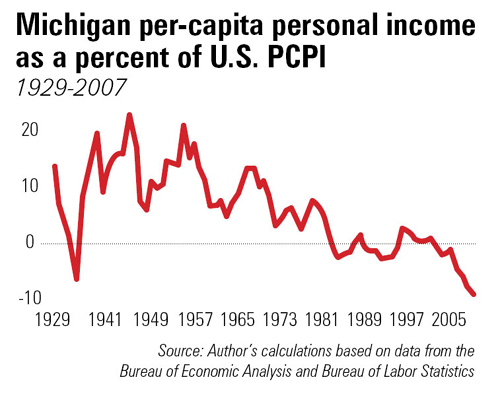
Per-Capita Personal Income is arguably the finest measure of material well-being of a population. The indicator below shows that Michigan’s income levels have been below the U.S. average (the "0" line) for seven consecutive years. In 2007, Michigan’s per-capita personal income was 9 percent below the national average. This year, 2008, will mark the eighth year in a row of Michigan’s relative poverty — an economic status that is unprecedented in the 75 years since the Great Depression.
These income numbers alone are enough to make a person despair over Michigan’s economic future. Unfortunately, they are not the only ones that paint a picture of a state in decline. Michigan’s per-capita state Gross Domestic Product (the value of all goods and services produced within our borders) has tanked, our unemployment is the highest in the nation and, not surprisingly, from July 2006 to July 2007, Michigan was one of only two states in the nation to lose population in net terms.
While Michigan has many positive attributes, the following rhetorical question must be asked:
Does anyone outside of Lansing really believe that these metrics will improve because of last year’s $1.4 billion tax hike and new sundry fees and regulations?
Raising the cost of anything only reduces the quantity demanded of it. Raising the cost of living, working and investing in Michigan will only do the same.
David Littmann is senior economist and Michael D. LaFaive is director of the Morey Fiscal Policy Initiative at the Mackinac Center for Public Policy. A Taxing Question was originally published on Feb. 8, 2008.
Michigan Capitol Confidential is the news source produced by the Mackinac Center for Public Policy. Michigan Capitol Confidential reports with a free-market news perspective.