


Bill would cut required training hours for barbers
Michiganders seeking to cut hair must complete more training hours than police officers and EMTs


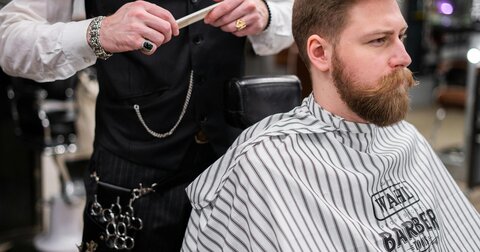
Michigan residents who want to become barbers will face fewer regulatory barriers from the state should legislation introduced in Michigan become law.
House Bill 4927, introduced by Rep. Parker Fairbairn, R-Harbor Springs, would decrease the number of hours a person must spend as an apprentice before becoming a licensed barber. The requirement would drop from 1,800 hours to 1,500 hours.
“This bill is a small part of a larger effort to reign in the excessive rules, regulations and requirements that the state places on businesses and those that would seek to enter into Michigan-based professions,” Fairbairn wrote in a Nov. 6 press release.
The bill was reported to the Committee on Economic Competitiveness, which recommended that it pass.
The state requires about 300 more hours of training compared to most other states, according to Fairbairn. Reducing the requirement by 300 hours would bring Michigan in line with other states, he wrote.
Fairbairn did not respond to Michigan Capitol Confidential’s request for comment.
An expert on the state’s occupational licensing regime told CapCon that a 1,500-hour requirement is still too high and creates a barrier for Michiganders who want to pursue the work of barbering.
“There is no good reason that barbers in Michigan need 300 more training hours than cosmetologists — are men safer in shops or getting better haircuts?” said Jarrett Skorup, vice president of marketing and communications at the Mackinac Center for Public Policy. “Our laws are arbitrary and absurd and block working class people from jobs and I'm happy lawmakers are doing something about it.”
By comparison, police officers, who are trained to use lethal force, are required to complete just 615 hours of training that complies with the Michigan Commission on Law Enforcement Standards.
An emergency medical technician must obtain 194 hours of training to receive a state-issued license.
The Mackinac Center, a leading voice in calling for occupational licensing reform, has published a list of occupations and their licensing requirements.
CapCon emailed two professional organizations, the Michigan Barber School and the Michigan Association of Beauty Professionals, seeking comment. Neither replied.
Michigan Capitol Confidential is the news source produced by the Mackinac Center for Public Policy. Michigan Capitol Confidential reports with a free-market news perspective.