


College enrollment is seeing a flight to quality, report says
Enrollment up at U of M-Ann Arbor, other institutions at which students are more likely to complete their program



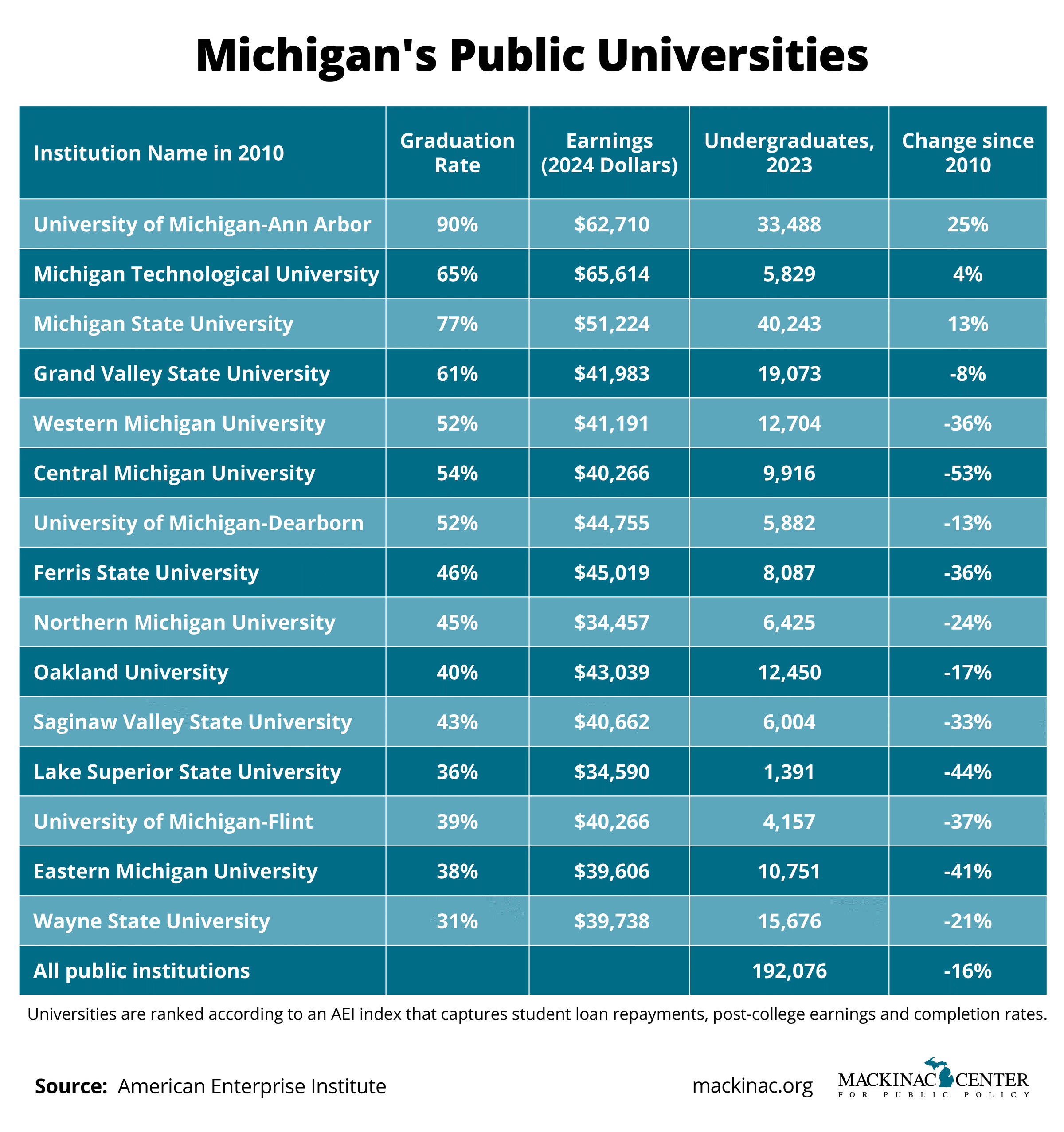
Nearly all of Michigan’s public universities have seen student enrollment drop from 2010 numbers while three have a higher number. Enrollment at the state’s public 15 universities dropped by 16% from 2010, with roughly half of the institutions losing at least one-third of their undergraduate population, according to a new report.
Three Michigan universities gained students since 2010, the national peak for enrollment. That’s one finding of the American Enterprise Institute, which drew on data from the U.S. Department of Education’s College Scorecard. Enrollment was up by 25% at the University of Michigan-Ann Arbor (25%), by 13% at Michigan State University and by 4% at Michigan Technological University.
But enrollment slid at the other 12 public institutions, according to data the institute sent to Michigan Capitol Confidential in an email. Declines usually exceeded 25%. Central Michigan University has the greatest loss, shedding 53% of its students.
Enrollment in undergraduate programs across the country has declined by nearly 20% since 2010, according to “Learning with their feet,” a report written by American Enterprise Institute senior fellow Preston Cooper. The national trend, repeated in Michigan, favors institutions whose students are more likely to graduate and pay their loans.
The enrollment decline occurred mostly in low-quality institutions, Cooper said in his report, with high-quality institutions seeing an enrollment surge. “Students seem to have some sense of variation in college quality and make their enrollment decisions accordingly,” he wrote.
Cooper created an index by assigning a score to each institution that is based on its students’ academic and financial success. A university would receive a high score if most of its first-year students graduated on time, made timely payments on their student loans and had a higher income six years after they first enrolled. The report gives a score to colleges, universities, trade schools and other institutions across the nation.
Institutions that score highly on Cooper’s index differ substantially from those with the lowest scores. More than 71% of students who entered a college in the top fifth of the ranking graduated on time, but only one of every six students (16.3%) who entered a bottom-quintile college did so.
In the Wolverine State, the top spot went to the University of Michigan’s Ann Arbor campus, with 90% of its students completing their studies. Wayne State University was at the bottom of the ranking, with 31% of students finishing on time. But Wayne State was not the only poor performer. The completion rate was less than 50% at eight of Michigan’s 15 public universities.
Earnings varied greatly across institutions. Students across the nation who entered a university in the top 20% had a median income of $50,432 six years after first enrolling. Students who attended a university in the bottom 20% had a comparable number of only $29,507.
A similar pattern played out in Michigan. Students who enrolled at Michigan Technological University had the highest median income after graduation of all state universities here — $65,614. Those who enrolled at Northern Michigan University, by contrast, earned 52% of that amount, or $34,457. These numbers include both those who completed a degree and those who did not.
“While enrollment and standards at universities have changed a lot since 2010, one thing hasn’t: The state government’s payments to universities,” James Hohman, director of fiscal policy at the Mackinac Center for Public Policy, told CapCon in an email. “Lawmakers transfer $1.7 billion from taxpayers to the schools and ask little in return.”
Politics, not performance, is the key to how much each university receives, he said before calling for more explicit criteria. “Lawmakers should find out how they’d like the schools to benefit the public and tie its payments to those ideas, if the schools deserve taxpayer support at all.”
Michigan Capitol Confidential is the news source produced by the Mackinac Center for Public Policy. Michigan Capitol Confidential reports with a free-market news perspective.
 U-M threatened pro-Palestinian students, union alleges
 Free speech policies: stronger than ever on university campuses, advocacy group says