


Comstock Schools: Teachers could get raise by dropping MESSA for cheaper health plan
Michigan schools grapple with rising insurance costs



The superintendent of Comstock Public Schools says teachers could save money and receive a pay raise by leaving the expensive health plan provided by the Michigan Education Special Services Association.
“Our teachers currently have MESSA, and it is an extremely expensive insurance program compared to the West Michigan Health Insurance Pool that our administrators and other covered employees have,” Comstock Superintendent Jeff Thoenes wrote in an email to Michigan Capitol Confidential.
Thoenes said the district included a comparison of the two plans in its initial bargaining proposal to the teachers union. Switching from MESSA to the less expensive pool would reduce teachers’ healthcare expenses and leave the district enough money to increase wages.
“Our teachers would save a lot of money if we shifted from MESSA to WMHIP, and the District could finance a wage increase at the same time,” Thoenes wrote.
The president of Comstock’s teachers union has publicly criticized the rising cost of educators’ health coverage under MESSA, which is affiliated with the Michigan Education Association, the state’s largest teachers union.
Kim Sandefur is a Comstock math teacher and president of the Comstock Education Association, a local affiliate of the Michigan Education Association.
Sandefur testified before the state Senate Labor Committee in January 2025 about the financial burden healthcare costs placed on her family. She told lawmakers that her family’s deductible increased from $1,000 to $4,000 after she switched to a high-deductible plan. Her 8-year-old daughter became ill shortly before the end of 2024 and was taken to an emergency room on New Year’s Day, where she was diagnosed with pneumonia.
The medical expenses Sandefur incurred that January exceeded her monthly income, she testified.
“As a parent, I was sickened by the fact that insurance costs are now factoring into whether or not I can afford to seek medical treatment for my child,” Sandefur said.
High insurance costs make it hard to recruit more school staff, Sandefur said.
“We are struggling to recruit and retain highly qualified teachers as it is,” Sandefur testified. “They should not have to choose between healthcare and the job that they so love doing.”
Sandefur confirmed in a phone call with CapCon that the district proposed a change in the health plan during the most recent bargaining session.
“We are awaiting a presentation from both companies in two weeks,” Sandefur said, “so we can compare apples to apples and make informed decisions that will be in the best of interest of our membership.”
Comstock pays as much as $20,180 annually toward an employee’s family health insurance plan. The district uses the “hard cap” option permitted under Michigan’s 2011 public employee health benefits law because it costs the district less than paying 80% of each plan’s cost, Thoenes said.
The law, enacted under former Gov. Rick Snyder, requires public school districts and local governments to choose between two contribution limits. Employees must either pay at least 20% of their insurance costs, or the employer’s contribution is limited to a state-adjusted dollar amount.
MESSA administers health benefits underwritten by Blue Cross Blue Shield of Michigan. Its most recent publicly available federal tax filing lists several MEA officials on MESSA’s board of trustees, including MEA President Chandra Madafferi and MEA Vice President Deven Parrish.
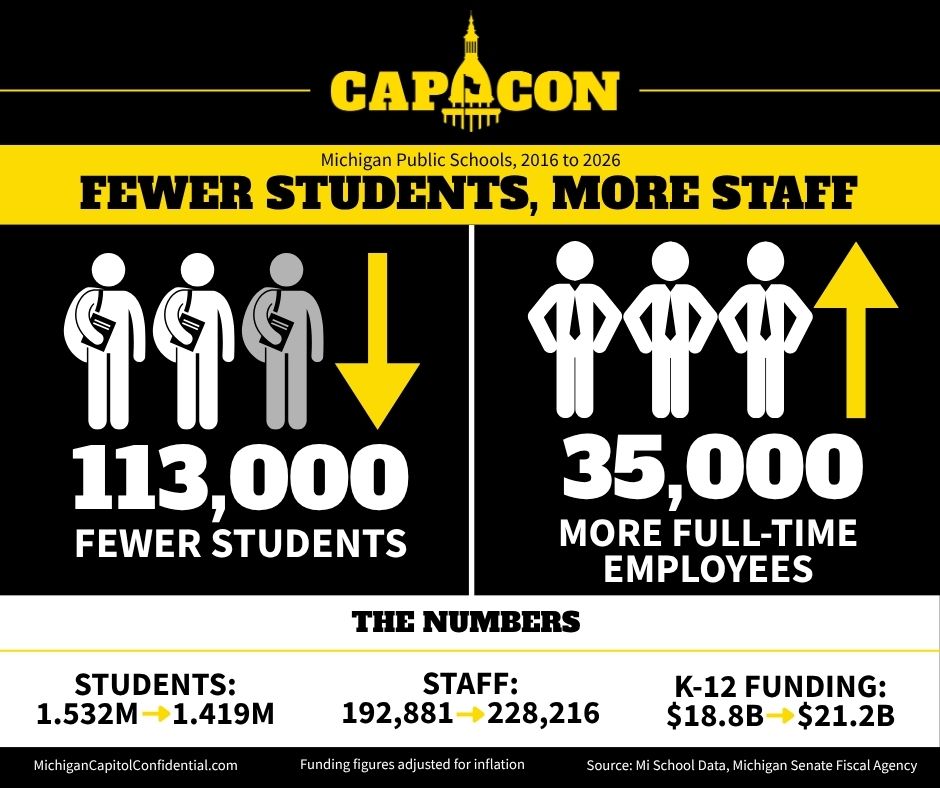
School staffing levels in Michigan have grown since 2016, while the number of students has declined. Meanwhile, taxpayers have given record funding to schools.
 Mackinac Center for Public Policy
Michigan Capitol Confidential is the news source produced by the Mackinac Center for Public Policy. Michigan Capitol Confidential reports with a free-market news perspective.
 Dansville teachers now pay 20% of health premiums after 13 years of paying nothing
 House votes for parental access to medical records of minor children
 Michigan spends record amount on schools, gets worse reading scores