


Fraud-riddled Michigan health department will continue to push DEI through 2030
CapCon records cache shows state’s largest agency ignoring federal orders



When the state health department discovered that it had paid $14 million in fraudulent food stamp claims in 2024, the department didn’t make stopping fraud a priority.
Instead, the Michigan Department of Health and Human Services doubled down on its whole-of-organization approach to increase diversity, equity, and inclusion. Michigan Capitol Confidential discovered the department’s obsessive mission, which it has not mitigated in any way as the people of Michigan and the United States register increasingly strong disapproval of wokism, in hundreds of pages of documents obtained through a records request.
The health department, which employs over 14,000 people, hasn’t responded to a request for comment.
The department has a tough job. It provides electronic benefit transfers to 1.4 million people. It is also legally responsible for about 10,000 children in foster care.
The state took about 4,000 children from a parent, guardian, or a runaway’s home in 2024, according to documents obtained through a records request.
In January, the White House ordered a halt to DEI programs using federal money. The move followed sweeping national and local elections in which voters registered a strong reaction against the excesses of woke ideology — a cross-cultural popular attitude that is also widely documented by public opinion polling. But it appears that Michigan’s health department ignored that directive.
“The Biden Administration forced discrimination programs, going by the name ‘diversity, equity, and inclusion’ (DEI), into virtually all aspects of the Federal Government, in areas ranging from airline safety to the military. This was a concerted effort made clear on Biden’s first day in office, when he issued Executive Order 13985, ‘Advancing Racial Equity and Support for Underserved Communities Through the Federal Government.’”
That order and the federal government’s nearly absolute control over state health policy pushed state-level health departments around the country to adopt punishing DEI strictures. Michigan's health department apparently ignored more pressing issues such as the doubling of welfare fraud from 2023-2024, Michigan Capitol Confidential reported recently.
One employee, Ashanta Butler, was fired after years of falsifying documents.
Michigan’s health department delayed upgrading its Bridge food stamp cards for over 10 years, attracting criminal networks that targeted the program to steal from Michigan taxpayers while interrupting the flow of free food to the state’s poorest residents. Criminals install skimmers at public places such as grocery stores, liquor stores, and gas stations. Those skimmers copy electronic benefit transfer card data so that criminals can deplete food funds before the intended recipients can spend them.
In 2024, the health department mailed more than 269,000 replacement Bridge cards, at an average of 738 every day. CapCon reported the waste, fraud, and abuse at least 16 times, and Rep. Jason Woolford, R-Howell, introduced a reform bill that has been enacted. The department will upgrade Bridge cards to more secure chip technology starting Jan. 1.
Woolford said lawmakers should break up the department.
CapCon has requested every complaint submitted to the health department from 2023 and 2024 through an open records request, as well as a list of every employee.
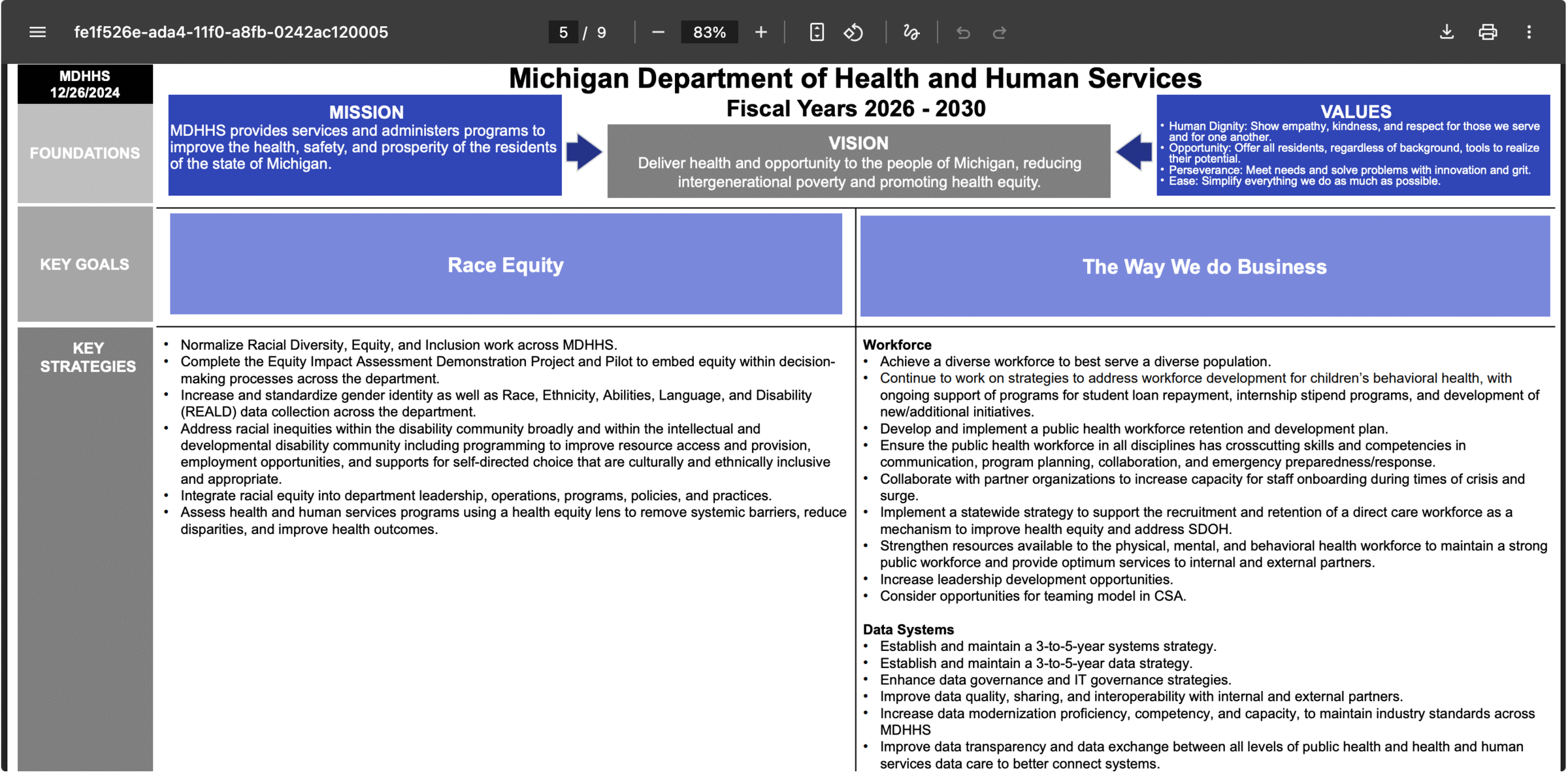
The agency prioritized “race equity” and the following key strategies.
-
Normalize Racial Diversity, Equity, and Inclusion work across MDHHS
-
Complete the Equity Impact Assessment Demonstration Project and Pilot to embed equity within decision-making processes across the department
-
Increase and standardize gender identity as well as Race, Ethnicity, Abilities, Language, and Disability, data collections across the department
-
Address racial inequities within the disability community broadly and within the intellectual and developmental disability community including programming to improve resource access and provision, employment opportunities and supports for self-directed choices that are culturally and ethnically inclusive and appropriate.
-
Integrate racial equity into department leadership, operations, program, policies, and practices.
-
Assess health and human services programs using a health equity lens to remove systemic barriers, reduce disparities, and improve health outcomes.
-
Ensure MDHHS employment opportunities are posted on diverse platforms to recruit underrepresented populations.
-
Require all interviewers be trained in diversity hiring.
-
Evaluate all funding sources for opportunities for innovation, inefficiencies, or reallocation.
-
Ensure MDHHS employment opportunities are posted on diverse platforms to recruit underrepresented populations.
-
Require all interviewers be trained in diversity hiring. Manage organizational performance
-
Identify trends and disparities within geographical, racial, and ethnic groups, including intersectional data (i.e., disability and race).
Michigan Capitol Confidential is the news source produced by the Mackinac Center for Public Policy. Michigan Capitol Confidential reports with a free-market news perspective.
 District health department brews up food license dispute with youth group
 Michigan’s SNAP administration costs to jump $94 million as feds shift burden to states
 Six-figure salaries increase by 474% at Michigan health department