


Michigan clerks struggle with expanded voting requirements
Amendments cost local governments and strain election operations, experts say at Mackinac Center event


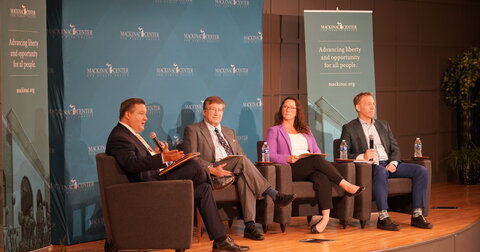
Michigan township clerks say that expanded voting requirements adopted in recent years have increased election costs and staffing demands, with the burden falling most heavily on lower-population townships.
Michigan voters approved constitutional amendments in 2018 and 2022 that expanded absentee voting, added same-day registration and required at least nine days of early in-person voting for statewide and federal elections.
Local election officials say those changes have shifted elections from a single-day operation into a weeks-long administrative process that requires additional staffing and planning regardless of turnout.
Michigan’s election system is highly decentralized, relying on local clerks to administer elections at the township and municipal levels.
“We’re highly decentralized compared to most other states,” said Kent County Clerk Lisa Lyons during a May 26 event hosted by the Mackinac Center for Public Policy.
“Our elections aren’t administered centrally by the Secretary of State or even by Bob and I at the county, but by nearly 2,000 elected or appointed local clerks,” she added.
Clerks say the expanded requirements have also increased administrative workload, including during low-turnout elections.
“In May, the average turnout is 15% to 20%,” said Allegan County Clerk Bob Genetski. “It is costly for the townships.”
Genetski also pointed to cost differences between different voting methods used during the 2024 presidential primary in Hopkins Township.
He said Election Day voting costs about 50 cents per voter, while absentee voting costs approximately $4.50 per voter.
Early in-person voting costs about $135 per voter, though he said the figure reflected a small number of voters since the county shared costs with another jurisdiction.
Midland County Elections Director Ann Manary said in a phone interview that the nine days of early voting required by state law have increased costs for local governments.
“Yes, obviously, the nine days of early voting has created a substantial cost for jurisdictions,” Manary said. “Here in Midland, the county actually handles running early voting, so the cost is, you know, paid by the county. We do get some reimbursement from the state of Michigan for that, but ... essentially it’s all taxpayer dollars.”
Lyons also pointed to earlier changes approved under Proposal 3 in 2018, which expanded absentee voting, same-day registration and other access provisions.
She said many of the reforms now sit in the state constitution, making it difficult to revise them through legislation.
“When we talk about election reforms, some of these commonsense changes, they’re going to be very, very difficult to make because now they’re in the constitution,” Lyons said.
These changes, Lyons said, should have been made legislatively.
The Michigan Department of State says that early voting was adopted to expand voter access and allow voters to cast ballots before Election Day in a process similar to traditional in-person voting.
Gov. Gretchen Whitmer’s proposed 2026–27 budget sets aside more than $43 million for new voting equipment, according to state budget documents.
Election officials across Michigan say the funding would support upgrades to election infrastructure and help ensure that election equipment meets federal standards.
If lawmakers do not approve the spending, local clerks would face higher administration costs, which have increased in recent years as the state’s election laws have become more complex.
Manary added that sometimes, local governments receive no state reimbursement for election-related expenses.
“For instance, we had a special 35th District Senate election, and we received zero reimbursement from the state for that. That was a cost that the county and the township had to bear,” she said. “Elections are very expensive. Ballots tend to run around 75 cents per ballot.”
Mike Reitz, executive vice president of the Mackinac Center for Public Policy, wrote in an article titled “What Election Reforms Are Actually Possible” that Michigan should evaluate recent election changes before adopting new ones.
“Michigan has enacted major election law changes in recent years,” Reitz wrote. “Before layering on more changes, policymakers should examine whether those recent reforms are working or if they have created unintended consequences.”
When asked what might surprise people about the amount of work involved in administering elections, Manary pointed to the long preparation and the behind-the-scenes work voters do not see.
“People come to the polls on Election Day, and they see the work that we do, but they don’t see the background that leads up to that,” Manary said. “We’ve been preparing for the August election since April. It’s a very time-consuming process.”
The Michigan Association of Municipal Clerks did not respond to emailed requests for comment.
[Editor’s note: this piece has been updated to note that Lisa Lyons is the Kent County Clerk]
Michigan Capitol Confidential is the news source produced by the Mackinac Center for Public Policy. Michigan Capitol Confidential reports with a free-market news perspective.
 Comstock Schools: Teachers could get raise by dropping MESSA for cheaper health plan
 Critics challenge value of Make MI Home grants
 Michigan election misinformation hotline stuffed with spam