


Michigan hands out $112M in 2026 summer food cards to 937,403 students
No such thing as a ‘free’ lunch: Error rate could cost Michigan $300 million


Michigan is handing out hundreds of thousands of pre-loaded Supplemental Nutrition Assistance Program cards, expanding its $248 million school lunch program despite SNAP security holes that have left taxpayers and cardholders vulnerable to criminal looting.
The cards are intended to cover summer vacation for students, when children do not have access to publicly funded school meals. The Michigan Department of Health and Human Services administers the federal SUN Bucks program that gives each child $120 via a Bridge card that can be used at 10,000 retailers statewide.
The following individuals are eligible for SUN Bucks:
-
Children ages 6 to 18 who receive Supplemental Nutrition Assistance Program (SNAP), Temporary Assistance for Needy Families (TANF) or Medicaid benefits between July 1, 2025, and Aug. 31, 2026. They will be automatically enrolled. Medicaid recipients’ income must be at or below 185% of the federal poverty level.
-
Students who fill out a Nutrition and Education Benefits Application and are approved to get free or reduced-price meals through the National School Lunch Program or School Breakfast Program.
-
Children approved through the summer EBT application process.
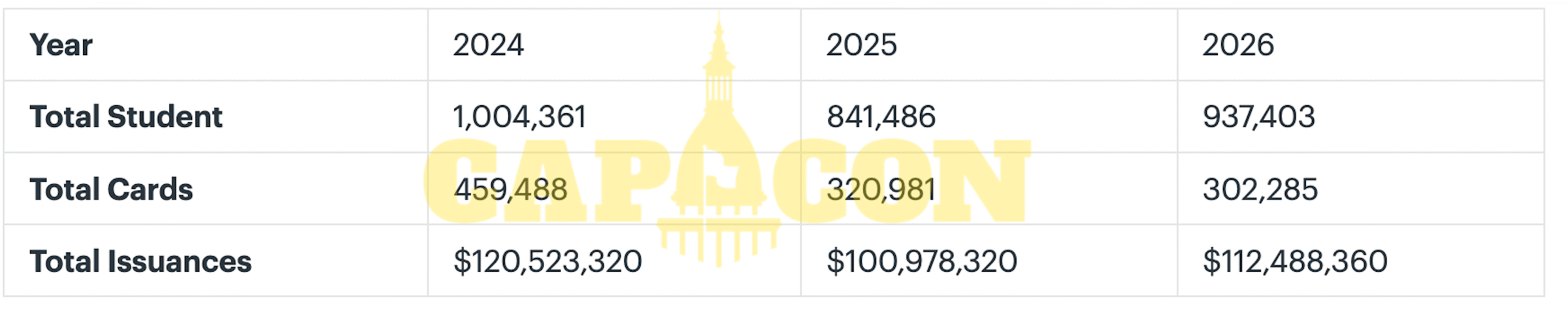
The Summer Electronic Benefit Transfer program started in 2024. The state health department issued over $120 million that year to 1,004,361 students via 459,488 cards.
In 2025, Michigan issued more than $100 million to 841,486 students via 320,981 cards. So far in 2026, Michigan has issued more than $112 million to 937,406 students via 302,285 cards.
Michigan Capitol Confidential obtained the data through a records request.
“Michigan children need consistent access to nutritious food to grow, learn and thrive,” Elizabeth Hertel, former department director said in a June 16 news release. “The Summer EBT program, in addition to our other nutrition assistance programs like WIC and SNAP, helps us close the summer hunger gap by providing every eligible child with funding for nutritious food, addressing one of the key social determinants of health – food insecurity.”
The state health department takes several steps to make sure that families enrolled in the Summer EBT are eligible. It automatically verifies income through family participation in existing programs such as SNAP, TANF, and Medicaid, with the requirement that the income be at or below 185% of the federal poverty level.
It also uses school data to confirm the identity of children approved for free or reduced‑price school meals.
The state also reviews income information submitted through the Summer EBT application when families are not automatically qualified.
About one out of every 10 benefits the state health department disbursed in fiscal year 2025 were either too much or too little, according to data released last month from the U.S. Department of Agriculture. Michigan with a payment error rate of 9.89%, the department says.
CapCon spoke with one Michigan family who received a Summer EBT card in June for their minor child, despite not qualifying for the benefits. Mistakes like these are why Michigan could face a federal penalty of roughly $300 million in late 2027. The state’s error rate exceeds the federal goal of 6%.
CapCon filed a records request seeking documents about Summer EBT benefits that were reported stolen in the summers of 2024, 2025 and 2026. The state health department said the cost for supplying those documents would be more than $9,000 for that information, and we are trying to shrink that cost.
Recipients must spend their benefits within 122 days. Unused benefits will expire.
Michigan Capitol Confidential is the news source produced by the Mackinac Center for Public Policy. Michigan Capitol Confidential reports with a free-market news perspective.
 Show your work: Bill would force Michigan to open its SNAP books
 Michigan lawmakers eye separating legal SNAP spending from fraud
 Michigan House approves adding chips to SNAP cards