


Michigan licenses more than 1 in 5 jobs
Permission-to-work rules lock many people out of Michigan’s labor force


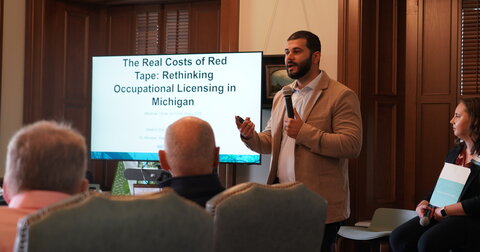
Michigan’s arbitrary and expensive licensing laws have little to do with public safety, a panel of experts told participants at a recent forum.
The state’s work requirements also push up prices for consumers and keep willing workers out of jobs, according to Jarrett Skorup, vice president of marketing and communications at the Mackinac Center for Public Policy. Michigan requires a license to work in 175 occupations — from barbers to auto mechanics. These restrictions affect more than one million workers, or about one in five members of the state’s workforce.
Many of these license requirements defy logic and common sense. Barbers in Michigan need more training hours than airline pilots need for their federal license.
“Having too many rules is the same as having none,” Skorup said during a June 10 forum at the Michigan Capitol. “There’s no way anyone can keep up with it, and all you’ve done is make the process more confusing.”
The Brookings Institution, the Institute for Justice and other organizations say these mandates are often unnecessary, raise consumer costs, and make it harder for people with criminal records or out-of-state licenses to work.
“Excess licensing hinders the American workforce,” Skorup said, citing 2017 comments from then-Secretary of Labor Alexander Acosta. “It’s a costly, complex economic barrier for Americans moving state to state, and it prevents Americans from looking to leverage technology.”
Panelists at the June event called for reforms, including universal license recognition, under which Michigan would recognize licenses issued by other states.
Deeb Eid, a pharmacist and regulatory affairs manager at CVS Health, said reforms could address worker shortages and make Michigan more competitive. He added that Michigan ranks 29th-worst among licensing burdens nationwide.
Eid supported universal recognition, saying that excessive licensing costs the state an estimated 125,000 jobs and $10.4 billion in higher prices each year. The burden “incorporates people like veterans, spouses, remote workers, new graduates, border-state practitioners, and telehealth providers,” he said.
Twenty-one states have adopted a universal recognition policy since 2013.
Michigan’s licensing laws make it especially difficult for individuals with a criminal record to reenter the workforce, said Ally Alfonsetti, a legislative strategist with Prison Fellowship, a nonprofit that advocates for criminal justice reform. More than 15,000 legal barriers exist nationwide, preventing people with criminal records from obtaining licenses. One in four jobs nationally require a license.
“Over 93% of formerly incarcerated people between the ages of 25 and 44 are unemployed or actively looking for a job,” she said.
“We’re missing out on this opportunity to tap into a workforce that wants to contribute to society,” Alfonsetti added. “Many have already received training behind bars and are ready to work when they return home.”
The unemployment rate for formerly incarcerated individuals is five times higher than average, and about 50% report no income even four years after release, she said.
A criminal record should not automaticaly disqualify a job applicant, according to Alfonsetti.
“When determining whether to grant an occupational license, consideration of a criminal record should be based on a direct relationship between the crime in question and the specific license being requested” she said. “But also, not eliminating an entire group from accessing the workforce to pay taxes, contribute to their community, and be productive members of society.”
Skorup pointed to inconsistencies in how licensing rules are applied. Auto mechanics in Michigan pay $6 to take a test and get licensed, with no formal training required. Until recently, house painters paid $900 and completed 60 hours of training.
Other states have made reforms. Idaho’s Board of Pharmacy cut 60% of its rules with no rise in disciplinary actions.
Panelists at the Mackinac Center event urged Michigan to follow suit and reduce barriers to work. Those who benefit would include new residents, returning residents, and people looking to enter a new job. A reformed system of occupational licensing would increase competition and expand the labor pool, the panel concluded.
Michigan Capitol Confidential is the news source produced by the Mackinac Center for Public Policy. Michigan Capitol Confidential reports with a free-market news perspective.
 State agencies report wildly different remote and in-person work rates, records show
 Michigan employment declines after Whitmer’s right-to-work repeal
 Michigan schools see fewer students, more staff