


Teachers union distorts record on education spending
MEA Voice article long on broad claims, short on specifics


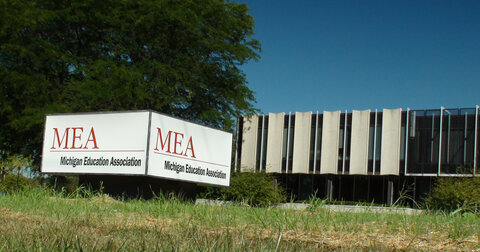
“MEA Labor Economist Tanner Delpier tells stories with data,” begins a December article on the Michigan Education Association’s website that mixes bits of truth with widely inaccurate claims.
Gov. Rick Synder, who was in office from 2011 through 2018, “presided over a steep, years-long decline in the state education budget, which hit bottom under his leadership in 2013,” writes MEA Voice editor Brenda Ortega.
Snyder’s first budget (the 2011-12 fiscal year) spent $11.09 billion of state revenues on schools, which was up from $10.80 billion in the 2010-11 budget, the last one under Gov. Jennifer Granholm. These numbers come from the Senate Fiscal Agency, which records state funds as either “state restricted” or “general fund.”
State funding increased to $11.21 billion under Snyder’s second budget. Each budget after that saw more state funds going to schools.
The 2018-19 budget, the last one Snyder signed into law, included $12.96 billion in state support for schools, or roughly 20% higher than provided under Granholm’s last budget.
“Education funding in Michigan still has not returned to peak levels reached in the early 2000s,” the union article said.
The statement is true as far as it goes, but it does not include a relevant fact, which is that student enrollment, a key driver of school expenses, has declined since then.
Michigan spent $6,391 per pupil in 2000, according to Michael Van Beek, director of research at the Mackinac Center for Public Policy. That is $12,271 per student in today’s dollars.
Per pupil funding was $14,911 in 2025, or 22% more than the inflation-adjusted amount for 2000.
Policymakers and media outlets routinely consider state scores on the National Assessment of Education Progress, often called the Nation’s Report Card. State comparisons are sometimes misleading, the union said, because some differences across states are within the margin of error.
“Score differences within the margin of error are not statistically meaningful, but news media and politicians use them to rank states and speculate about causes — even though the maker of the assessment (the National Center for Education Statistics or NCES) cautions against it.”
Whatever the limits of the national test, state assessments show a similar trend of declining performance.
“More than 60% of Michigan third graders, and nearly 58% of fourth graders, failed the 2025 state reading test – a greater proportion than last year,” Molly Macek, education policy director at the Mackinac Center wrote in a Sept. 9 essay.
Macek told Michigan Capitol Confidential that lawmakers need to take a careful look at student achievement if they wish to improve it.
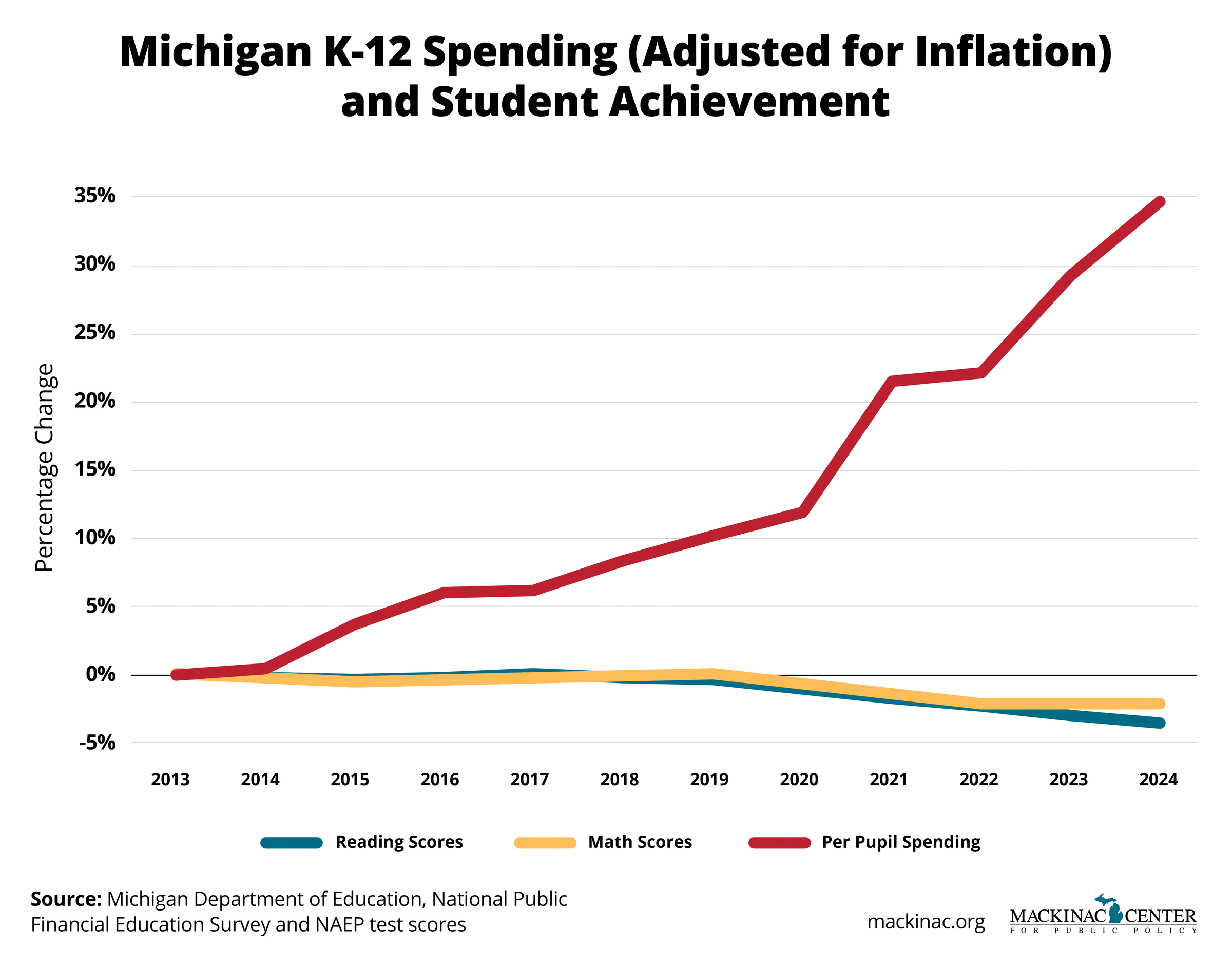
“Since 2013, per pupil funding has increased by nearly 35%, while reading and math performance has stagnated or declined,” Macek said.
Defending the status quo, she said, does a disservice to students and taxpayers alike.
The MEA did not respond to a request for comment.
Michigan Capitol Confidential is the news source produced by the Mackinac Center for Public Policy. Michigan Capitol Confidential reports with a free-market news perspective.
 State teachers union loses members, revenue
 Michigan spends $6.9M advertising 'cost-free' pre-K
 Michigan Education Association’s power is on a long decline