


Michigan recycles economic development schemes
Old ideas get repackaged under new names


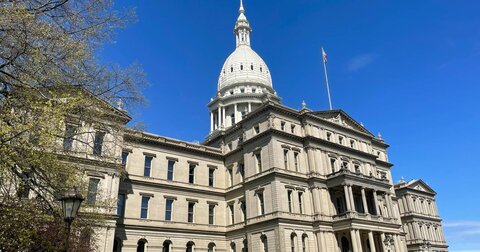
Gov. Gretchen Whitmer wants to reboot an economic development program. But one policy analyst says that rebranding an old strategy won’t make it work.
The 2026 Michigan budget eliminates funding for the Strategic Operating and Attraction Reserve program, the latest effort to promote economic growth through taxpayer-funded subsidies to select businesses. Gov. Gretchen Whitmer, who signed the 2026 budget into law, now touts a program called High-wage Incentive for Regional Employment, or HIRE. It would let certain companies keep the income taxes their employees would normally send to the public treasury.
Whitmer’s idea would revive another economic development scheme, Good Jobs for Michigan, developed under Gov. Rick Snyder. Crain’s Detroit Business reported on Whitmer’s plans on Oct. 7
Speaker Matt Hall, R-Richland Township, said he would work with the governor to make Michigan more attractive to businesses.
“We got to iron out details,” Hall said at an October press conference. “We got to figure out exactly what the right approach is for Michigan.” He called for ending the practice where “politicians write checks to corporations that have no loyalty to Michigan and create no jobs.”
Whitmer’s 2024 Make it in Michigan initiative defined plans for the new incentive program.
“Our current toolkit limits our ability to attract small and second-stage businesses. The HIRE Michigan Fund will lower overall payroll taxes for these firms. The value behind it is simple: the more you hire in Michigan, the more you should save in Michigan.”
Whitmer’s proposal renames Good Jobs for Michigan, said James Hohman, fiscal policy director at the Mackinac Center for Public Policy, in an email to Michigan Capitol Confidential. That program made six deals to create 9,454 jobs but only turned 511 into reality, according to the latest state report.
Good Jobs, created during the Snyder years, was itself a repackaged version of the Michigan Economic Growth Authority, or MEGA program, Hohman wrote in a 2017 blog post. Like other programs, he wrote, it failed to produce the economic results its supporters promised.
Lawmakers let the Good Jobs program expire in 2019, CapCon reported at the time.
Regardless of what state officials call their programs, Hohman said, the results are the same. “The money spent on them could be better spent elsewhere or kept in taxpayers’ pockets,” Hohman told CapCon.
Last year Hohman told members of the House Economic Development and Small Business Committee to add accountability measures to state subsidy programs. If the state continues to try to bolster the economy by using taxpayer-paid subsidies, it needs to establish measurements it can use to evaluate them.
Michigan Capitol Confidential is the news source produced by the Mackinac Center for Public Policy. Michigan Capitol Confidential reports with a free-market news perspective.
 Michigan Economic Development Corporation drops $743k on scratch-n-sniff magazine
 Michigan drops $1M so company can move six miles
 Michigan House package creates accountability requirements for taxpayer-funded incentives