


Michigan pays $125M in electric school bus grants
Battery bet faces long odds, high costs, low longevity


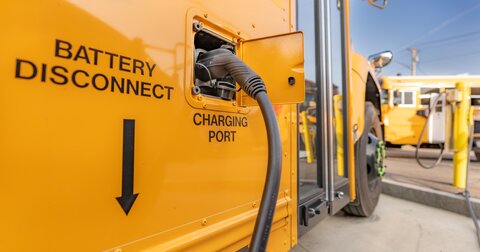
The Michigan Department of Education has paid $125 million for school buses powered by electricity and propane to replace diesel-powered fleets.
In the final round of grants announced Feb. 27, the department awarded $44 million to 27 school districts for the purchase of 99 electric school buses and 10 propane school buses, completing a total $125 million expenditure for the Clean Bus Energy Grant program.
“I’m proud of the work we’ve done to provide 100 school districts with 376 clean buses,” Gov. Gretchen Whitmer said in a press release. “In Michigan, we also passed a historic energy law to create jobs, lower energy costs, and grow clean, renewable energy across our state. Let’s keep working together to protect our air, land, and water for future generations.”
Education department officials said the grants would reduce harmful emissions and improve air quality, though the beneficiaries make up a small percentage of statewide schools. Michigan had 886 public school districts, including charter schools and intermediate school districts, in the 2020-21 school year, according to state data.
Electric vehicles are more expensive to purchase and maintain, and they are not cleaner for the environment, Dave Stevenson, director of energy and environmental policy director at the Mackinac Center for Public Policy, told Michigan Capitol Confidential.
“EV bus manufacturing is a small national business almost totally funded by federal subsidies that will most likely disappear,” Stevenson wrote in an email. Once those subsidies are gone, Stevenson said, buying propane-fueled buses will be the obvious alternative. He pointed toward the bankruptcy of electric bus maker Lion Electric, which last year voided manufacturer warranties in the United States.
There are not many options for maintaining electric buses, Stevenson said, and lack of spare parts could limit the life expectancy of a bus. Electric buses also face limited range, performance drops in cold weather, and battery fire risks that have prompted manufacturers to recommend storing vehicles outside. But the biggest obstacle might be price.
Electric school buses cost at least double the price of propane-fueled buses. Stevenson told CapCon that one electric bus costs between $700,000 and $900,000. By comparison, propane buses cost $300,000 to $500,000 apiece. Because propane is cleaner and cheaper than diesel, Stevenson expects propane buses to take a larger share as EV subsidies expire.
Experts also question claims that electric vehicles are cleaner for the environment.
“EVs are only as ‘clean’ as the electricity generated to charge their batteries,” wrote Jonathan A. Lesser, former adjunct fellow at The Manhattan Institute. “Despite the (Energy Information Agency’s) forecasts of large increases in wind and solar generation, and decreasing reliance on coal-fired power plants, my analysis found that the electricity generated to power EVs will emit far more SO2 and Nox than an equivalent number of (internal combustion vehicles).”
Asked for comment, the Michigan Department of Education referred CapCon to a statement Glenn Maleyko, state superintendent of public instruction, provided for the department’s press release.
“Our students deserve to travel to and from school in buses that are best for our local school districts and our environment,” said Maleyko. “The Clean Bus Energy Grant program helps us move toward Goal 3 in Michigan’s Top 10 Strategic Education Plan, to improve the health, safety and wellness of all learners.”
Michigan Capitol Confidential is the news source produced by the Mackinac Center for Public Policy. Michigan Capitol Confidential reports with a free-market news perspective.
 Nessel’s antitrust suit imagines widespread EV use, blocked by big oil
 Rochester school board member sues board over violation of freedom of speech
 Our Next Energy has repaid $3.3M out of $15M taxpayer loan