


Michigan sees steep decline in 2026 national economic ranking
Right-to-work repeal, higher minimum wage, high taxes drag down state’s score


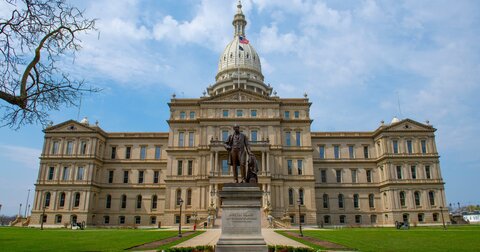
Michigan fell 13 spots in an annual ranking of economic competitiveness — the third worst fall for any state since reporting began in 2008.
The Great Lakes State dropped from 19th place nationally to 32nd in just one year, according to the 2026 edition of “Rich States Poor States,” an annual report published by the American Legislative Exchange Council. “Rich States Poor States” ranks the economic competitiveness of states based on differences in tax rates, minimum wage laws, liability costs and other state policies. The ALEC-Laffer State Economic Competitiveness Index considers a total of 15 variables to establish a state’s standing.
Michigan’s highest ranking came during the years of former Gov. Rick Snyder, when it reached 12th place in 2019.
Gov. Gretchen Whitmer posted on X April 21 that “$#1+ is expensive” and vowed never to stop working to lower costs for Michigan’s families.
But Jonathan Williams, president and chief economist at ALEC and one of the authors of the report, said changes during the Whitmer administration helped drag down the state’s ranking.
In an interview with Michigan Capitol Confidential, Williams listed three key policy changes the state made during Whitmer’s tenure. Each, he said, contributed to Michigan’s lower ranking in 2026: hiking the minimum wage, increasing personal and business income tax rates, and repealing the state’s right-to-work law.
Ending Michigan’s status as a right-to-work state, which happened in 2024, is a real problem for the state’s economic outlook, according to Williams.
Neighboring states of Ohio and Indiana have right-to-work, he added.
Businesses looking for a competitive environment are more likely to choose those states, Williams noted, but a Democratic trifecta that held power in 2023 and 2024 repealed Michigan’s right-to-work law.
Williams pointed to the state’s increased minimum wage as another stumbling block.
Minimum wage laws lead to fewer jobs, Michael LaFaive, senior director of the Morey Fiscal Policy Initiative at the Mackinac Center for Public Policy, wrote in a 2021 blog post.
“Research shows that while some workers may see their wages increased, others will lose their existing jobs or have a harder time finding others,” said LaFaive.
The state’s personal and business income taxes also drag down the state’s economic competitiveness, said Williams, adding that Michigan can help itself economically by reducing the tax burden it places on residents and businesses.
“Michigan has fallen behind in the general outlook of the states based on states that are racing to cut taxes right now to become more competitive,” Williams said.
He noted that Michigan has fallen behind on cutting personal and business income taxes. This is a bipartisan issue, Williams said, and some Democratic governors are looking to reduce taxes.
“Even Colorado Gov. Jared Polis has advocated for tax rate reductions on personal income tax and called for the complete elimination of the personal income tax in Colorado for economic development reasons,” he said.
The bottom line, according to Williams, is that states fall behind by standing still.
“And Michigan has fallen behind, as many of its key competitor states have realized, cutting taxes, especially taxes on small business and hardworking taxpayers, is an incredible economic benefit for them,” he said.
Whitmer did not respond to a request for comment.
Michigan Capitol Confidential is the news source produced by the Mackinac Center for Public Policy. Michigan Capitol Confidential reports with a free-market news perspective.
 Michigan Senate OKs paid sick leave compromise
 Whitmer undecided on federal scholarship program for K-12 students
 Wealth creators stung by Michigan minimum wage ruling