


Flint schools, legislator, want millions to demolish four buildings
Rep. Neeley seeks $8.8M for district that got $156 million in COVID funds


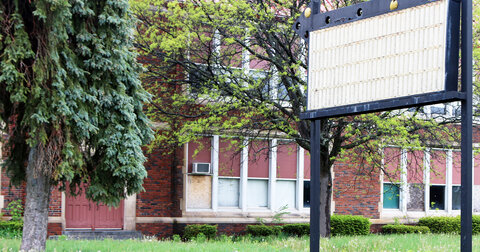
A state representative is seeking $8.8 million in demolition funding from the 2027 state budget for Flint Community Schools. The Flint district received $156 million in COVID relief funds in 2021.
Rep. Cynthia Neeley, D-Flint, requested the millions from state taxpayers to demolish four dilapidated school buildings that have been vacant for up to 17 years, according to a document in support of her earmark request. The owner of those buildings — Flint Community Schools — pays for security and maintenance.
“The district’s funds — intended for educating children — cannot continue absorbing the cost of maintaining these vacant buildings,” Neeley wrote in the request. “By demolishing them, not only is more money going into the classroom to educate students, but other benefits will also be realized such as reduction of blight, the protection of property values, and the improvement of public safety.”
The four buildings, which total 468,896 square feet, include two elementary schools, a middle school and a high school:
- Stewart Elementary School at 1950 Burr St.
- Anderson Elementary School at 3284 Mackin Rd.
- Northern High School at 3284 Mackin Rd.
- McKinley Middle School at 4501 Camden Ave.
The school district has “acted responsibly prioritizing literacy, student safety, instructional quality, and academic recovery,” Neeley wrote.
The Flint district in fact spent the largest part of its COVID relief funds on employees. The district used $24.6 million of the COVID funding on salaries, benefits, and bonuses. Each employee received a $20,500 bonus. Capital outlays came to a little more than $3 million for roof repairs and almost $15 million to “improve schools’ prevention of virus transmission,” according to reporting by Flint Beat.
Demolishing the long-vacant buildings would have been a permissible use of the federal relief funds.
“Eligible activities include ... demolition or deconstruction of vacant or abandoned buildings,” according to U.S. Treasury Department's final rule for the 2021 American Rescue Plan Act. “A state or locality may use its existing classifications of what is considered vacant or abandoned property under state law and local ordinances, as well as any corresponding processes for demolition, for these eligible uses.”
The act included “express authorization to use funds to address vacant and abandoned buildings, including commercial and industrial structures,” according to Bricker, Graydon & Wyatt, a law firm with offices in Ohio, Kentucky, Indiana and Tennessee.
Neeley and Flint Community Schools did not respond to requests for comment.
The district also spent, according to 2022 school board meeting minutes, $17.6 million from federal funds on roof repairs and other building improvements.
Though Neeley praised the district for emphasizing literacy, Flint still has one of the lowest rankings in the state for academic achievement.
Out of 191 fourth graders assessed in English Language Arts on the M-STEP, 179 students, or 94%, were either partially or not proficient in the 2024-25 academic year. Out of 99 seventh grade students assessed, 82 were not proficient in English.
Flint is also among the most well-funded districts in the state.
In 2023-24, Flint Community Schools received $40,647 in per pupil funding, according to the state’s Bulletin 1014. The district was allocated $33,151 per pupil in 2024-25, while the statewide average is about $14,960.
The district, according to a report on how it spent federal (ESSER III) funds, listed a category for contracted services to help students with tutoring. The report noted that $75,000 per school site would be available. Flint Beat reported that Flint schools spent a total of $825,000 on contracted services for after-school vendors.
Michigan Capitol Confidential is the news source produced by the Mackinac Center for Public Policy. Michigan Capitol Confidential reports with a free-market news perspective.
 Comstock Schools: Teachers could get raise by dropping MESSA for cheaper health plan
 State budget contains fewer earmarks than in years past
 At Flint Schools, teachers are doing great – students, not so much