


Hospitals see spike in visits amid Canadian wildfires
Search for blame generates additional smoke


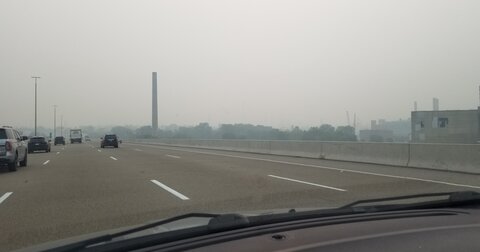
Michigan’s hospitals and health systems have experienced an uptick in patient visits linked to Canada’s wildfires, according to multiple sources.
“The smoke and degree of exposure is the worst I’ve seen over the past few years,” Dr. Jon Alterie, an emergency physician at McLaren Northern Michigan and McLaren Northern Michigan – Cheboygan Campus, told Michigan Capitol Confidential in an email.
Alterie attributes the increase in visits partly to patients’ having high awareness of the wildfires, a greater understand the risks, and willingness to take necessary precautions. But there has also been an increase in smoke-related emergencies exacerbated by existing and chronic conditions like asthma, COPD and emphysema.
Fox 2 Detroit reported a surge in hospitalizations due to wildfire smoke, including both healthy people and those with preexisting conditions.
Michiganders are no strangers to air quality troubles: ClickonDetroit reported in 2023 that Detroit had the worst air quality in the world, with a maximum Air Quality Index of 366.
But the air quality emergency from the fires in Canada and Minnesota may be Michigan’s worst on record, according to experts. Planet Detroit reported July 15 that the Air Quality Index was between 650 and 874, and Marquette had the index at 1008, according to Brian Niznansky, chief meteorologist at TMJ4 News in Milwaukee.
Kristen Meghan Kelly, a senior industrial hygienist and environmental specialist with a background in environmental engineering, warned that this month’s smoke is especially hazardous due to the small size of the particulate and the presence of volatile organic compounds.
“It's dangerous because it can go into the deep lung,” Kelly wrote in a July 16 Facebook post.
The international smoke emergency has spurred a political brouhaha. While wildfires have long been cited as symptoms of global warming, overbuilding or other issues, many critics now blame inadequate preparation and poor resource management.
Four congressmen from Michigan signed a strongly worded letter to Prime Minister Mark Carney accusing Canada of failing to take action over wildfire smoke that has plagued the state in recent years.
“We are done accepting apologies in place of action,” wrote Reps. John James, John Moolenaar, Lisa McClain, and Jack Bergman. “If Canada will not manage its forests to prevent these fires, the United States will look elsewhere, and act on our own, to protect our people. That means our own agencies exploring direct involvement in cross-border fuel reduction and firefighting capacity. It means reconsidering how much benefit of the doubt this relationship continues to earn on an issue where American lungs are paying the price for Canadian inaction, year after year. Sovereignty comes with responsibility, and the responsibility to prevent a foreseeable disaster from crossing into another country's airspace has not been met.”
The four congressmen did not respond to requests for comment. But the issue of inadequate forest management has become prominent as Americans look for answers to air quality emergencies.
By suppressing all fires rather than avoiding controlled burns, Canadian officials leave land largely unmanaged and allow forests to accumulate masses of potential fuel, ultimately leading to larger fires, according to research in June by Mackinac Center For Public Policy Energy and Environmental Policy Director David Stevenson and Dani Pohl, a Mackinac Center intern.
The Mackinac Center’s previous environmental expert extensively covered poor land management during the 2023 series of wildfires.
“Wildfires are here to stay, because wildfires have always been part of our history — and this year, and last year, and for many years prior, they have had more to do with poor forest management than with climate,” Jason Hayes wrote at the time. He cited research on forest management and wildfire policies in Michigan, Arizona, and North Carolina that focused on mitigating the severity of fires.
The Washington Post reported recently on similar claims, pointing out that controlled burns have been part of forest management since before the arrival of Europeans in the New World.
Michigan Capitol Confidential is the news source produced by the Mackinac Center for Public Policy. Michigan Capitol Confidential reports with a free-market news perspective.
 Gilchrist-led trip spent $245,000 on 2024 overseas trip
 Comstock Schools: Teachers could get raise by dropping MESSA for cheaper health plan
 Michigan schools see fewer students, more staff