


Ballot proposal would restrict free speech, opponents say
Prop 2 would quash political expression, run up new legal bills for taxpayers, some warn


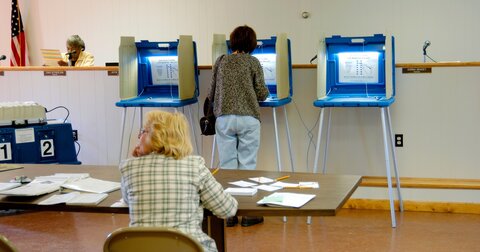
Michigan voters on Nov. 3 will decide a ballot proposal marketed as limiting the political influence of utilities and government contractors by amending the state’s campaign finance laws.
Proposal 2026-2, also known as Mop Up Michigan, would prohibit most regulated utilities, government contractors, and people closely connected to them from making some political contributions. It would also regulate certain forms of political communications.
Voters might likely support the measure in an attempt to stop utilities such as DTE Energy and Consumers Energy from asking for endless energy rate hikes, but the measure, if enacted, would gag the free speech of nonprofits, news sites, and job providers, the Michigan Chamber of Commerce argues.
“This egregious proposal appears to silence the voices of job providers and limit free speech for some while giving others, like labor unions, a free pass,” the chamber said in a July 22 press release.
The Mackinac Center for Public Policy issued a brief that explains the supporting and opposing views of the initiative.
The proposal could substantially increase free speech regulations, according to Michael Van Beek, the Mackinac Center’s vice president for research and author of the brief. The proposal, if approved by voters, would add new reporting requirements and laws on political communication for anyone who posts, publishes, or promotes public content that mentions a candidate, he told Michigan Capitol Confidential.
The measure would also expand the definition of campaign expenditure. Current law on campaign finance focuses on communications that expressly advocate for or against a candidate or ballot question. By contrast, the definition would expand to include any public communication that “promote, support, attack or oppose” a candidate or ballot question,” Van Beek said.
The proposal does not define these terms.
Certain employees of public utilities would be barred from contributing to candidates for state office, and their immediate family members would also be barred. The same would apply to employees or owners of government contractors.
The Mop Up Michigan proposal seeks to create a new category called an “electioneering communication.” This would expand what types of messages and content are subject to the state’s campaign finance laws, the Mackinac Center noted in its brief. ”Electioneering communication” would include any public message that occurs within 100 days of a general election or 30 days before a primary and special election, is targeted to the relevant electorate, and references a clearly identifiable candidate.
The proposal does not define “targeted to the relevant electorate,” the Mackinac Center said in its analysis.
A wide range of communications would be regulated, according to the analysis: newspaper articles, publicly distributed voter guides, trade association publications discussing candidates’ positions and social media posts by public officials. Internet advertising and other forms of general communication also could be covered. The proposal specifically says the new rules apply regardless of whether a communication expressly advocates a point of view.
“Proposal 2 would turn neutral, educational information about elections into regulated campaign speech,” Van Beek wrote in an email to CapCon.
Voters may find it more difficult to be informed about elections if organizations stop producing this information in response to the law, Van Beek added.
The group Protect MI Free Speech opposes Proposal 2. It argues that the measure could force nonprofits and other groups engaged in debates about public policy to comply with campaign finance requirements even when they do not advocate that voters elect or defeat a particular candidate.
“If passed, Proposal 2 will have a chilling effect on perhaps hundreds of thousands of people who don’t have anything personally at stake,” said John Sellek, spokesperson for Protect MI Free Speech in an email to CapCon.
The authors of the proposal are secret, Sellek continued.
“Perhaps in the ultimate betrayal of its volunteer base, millions and millions of dark money dollars are funding Proposal 2,” Sellek said.
No one knows who has financed the pro-proposal campaign, Sellek said, including the individuals who circulated positions or lawyers who wrote the proposal or researched state law.
Independent analysts say nothing like this proposal exists elsewhere, Sellek said. He predicts Michigan taxpayers would have to pay for expensive litigation should the proposal be enacted. The attorney general’s office is charged with defending state laws in court.
People United for Privacy, a national advocacy organization, said that Proposition 2 would touch nearly all nonprofit organizations and could imperil donor privacy. The measure also could discourage nonprofits from discussing public policy during election periods, it said.
“Michigan voters are being sold a false bill of goods that promises the impossible — to remove money from politics — while imposing unworkable rules on basic political speech,” Heather Lauer, chief executive officer of People United for Privacy Foundation, wrote in an email to CapCon.
Michiganders, Lauer said, would have fewer opportunities to join together to speak out on the issues that matter to them.
Corruption would become even worse, she added.
“Ironically, the proposal could increase corruption by making it more difficult for citizens to organize against powerful politicians and the interests already entrenched in Lansing,” Lauer said.
Mop Up Michigan did not respond to an email seeking comment.
Michigan Capitol Confidential is the news source produced by the Mackinac Center for Public Policy. Michigan Capitol Confidential reports with a free-market news perspective.
 Free speech policies: stronger than ever on university campuses, advocacy group says
 Michigan cities fight residents over free speech
 Last living delegate looks back on 1961 Constitutional Convention