


Michigan keeps losing share of US auto jobs
Billions in subsidies didn’t stop Michigan from losing half the auto jobs it had in 2000



Michigan has roughly half the automotive jobs it had in 2000, and other states have taken on an ever-larger role in making autos. This happened even as the state gave out nearly $23 billion in subsidies, mostly to the automotive sector.
Michigan had 156,600 auto manufacturing jobs in 2025, compared with 315,000 in 2000, according to federal employment data analyzed by James Hohman, fiscal policy director at the Mackinac Center for Public Policy.
Michigan accounted for 24% of the nation’s 1.3 million auto manufacturing jobs in 2000. By 2009, its share of national auto employment had dropped to 16.3%. Auto jobs fell to 108,500 by the end of the decade, a 66% decline.
The industry has recovered some jobs since then, but employment has grown faster in other states. National auto manufacturing employment reached 967,100 in 2025, compared with 664,100 in 2009.
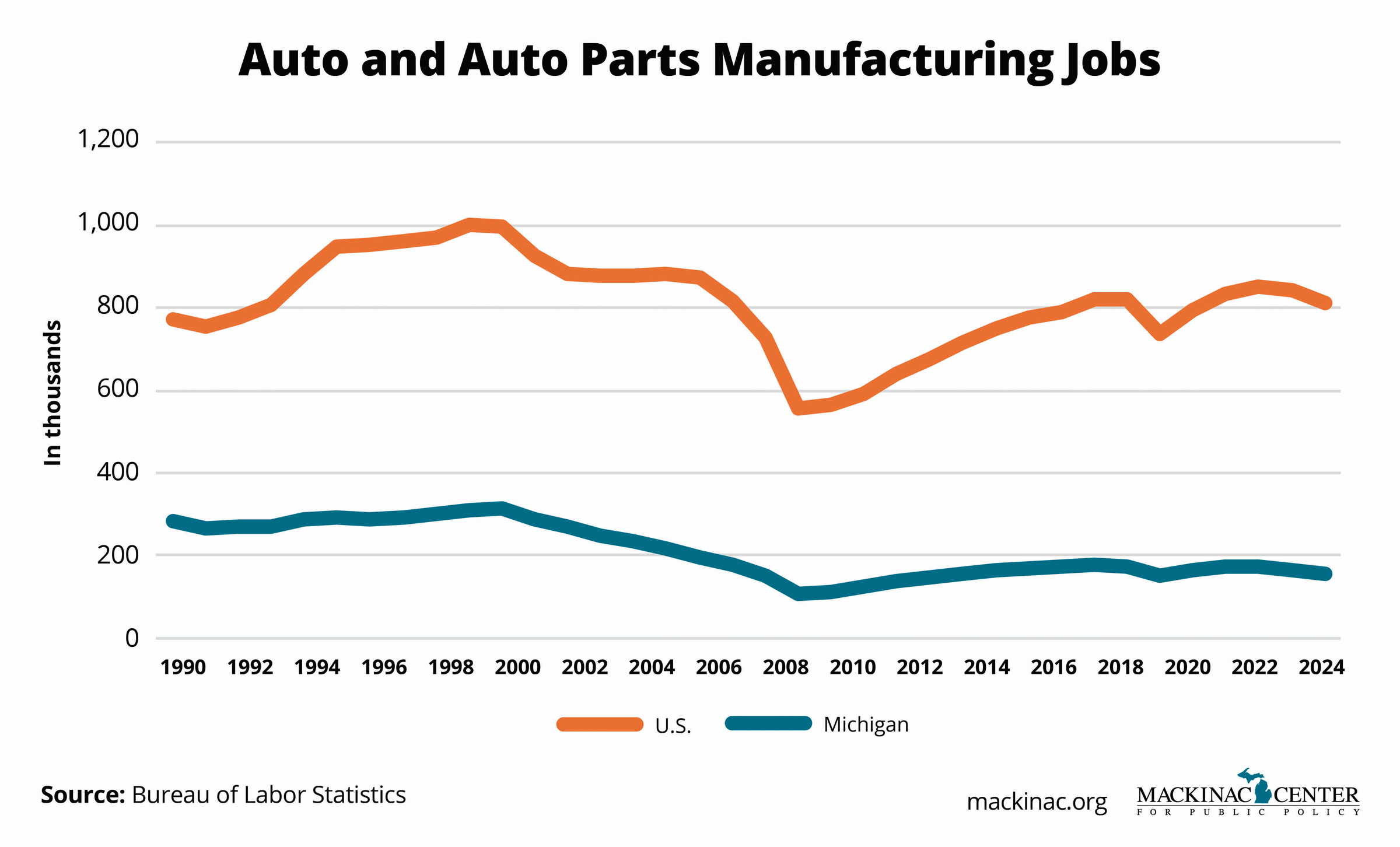
Michigan’s declining importance shows that business subsidies have failed to deliver, Hohman wrote in a 2024 analysis.
“I think it’s clear that auto and auto part manufacturers have found it more profitable to build things elsewhere,” Hohman said in an email to Michigan Capitol Confidential.
Hohman recommended that lawmakers create a more hospitable business climate instead of offering subsidies. The state could, he said, focus energy regulations on cost and reliability rather than reducing carbon dioxide emissions. The Center of the American Experiment, a Minnesota-based policy organization, agrees, adding that rising energy rates put Michigan at a competitive disadvantage.
Lawmakers could also let businesses immediately deduct the cost of their equipment from their taxable income, Hohman said. Allowing people to work for manufacturers without having to pay unions as a condition of employment would help as well.
Manufacturing in the auto and auto parts industry has shifted to right-to-work states over time, the National Institute for Labor Relations Research wrote in 2016. When Indiana and Michigan adopted a right-to-work law, 72.2% of auto manufacturing took place in right-to-work states, an increase from 24.4% in 2004.
Gov. Gretchen Whitmer and the Democratic-controlled Legislature repealed Michigan’s right-to-work law in 2023, making the state the first in nearly 60 years to undo a right-to-work policy through legislation.
General Motors and Ford did not respond to an email seeking comment, nor did the governor’s office.
Michigan Capitol Confidential is the news source produced by the Mackinac Center for Public Policy. Michigan Capitol Confidential reports with a free-market news perspective.
 Whitmer whiffs at real auto jobs numbers, again
 Michigan’s auto industry boondoggle: billions in subsidies, 287,000 jobs lost
 Michigan’s auto jobs drive South from 8 Mile to I-65