

Voters in 8 key districts approve more than $1 billion in school bonds
Michigan school bonds passed Nov. 3 will cost far more than their sticker price



Michigan voters approved nearly three-quarters of requests for new public education spending in the Nov. 3 elections.
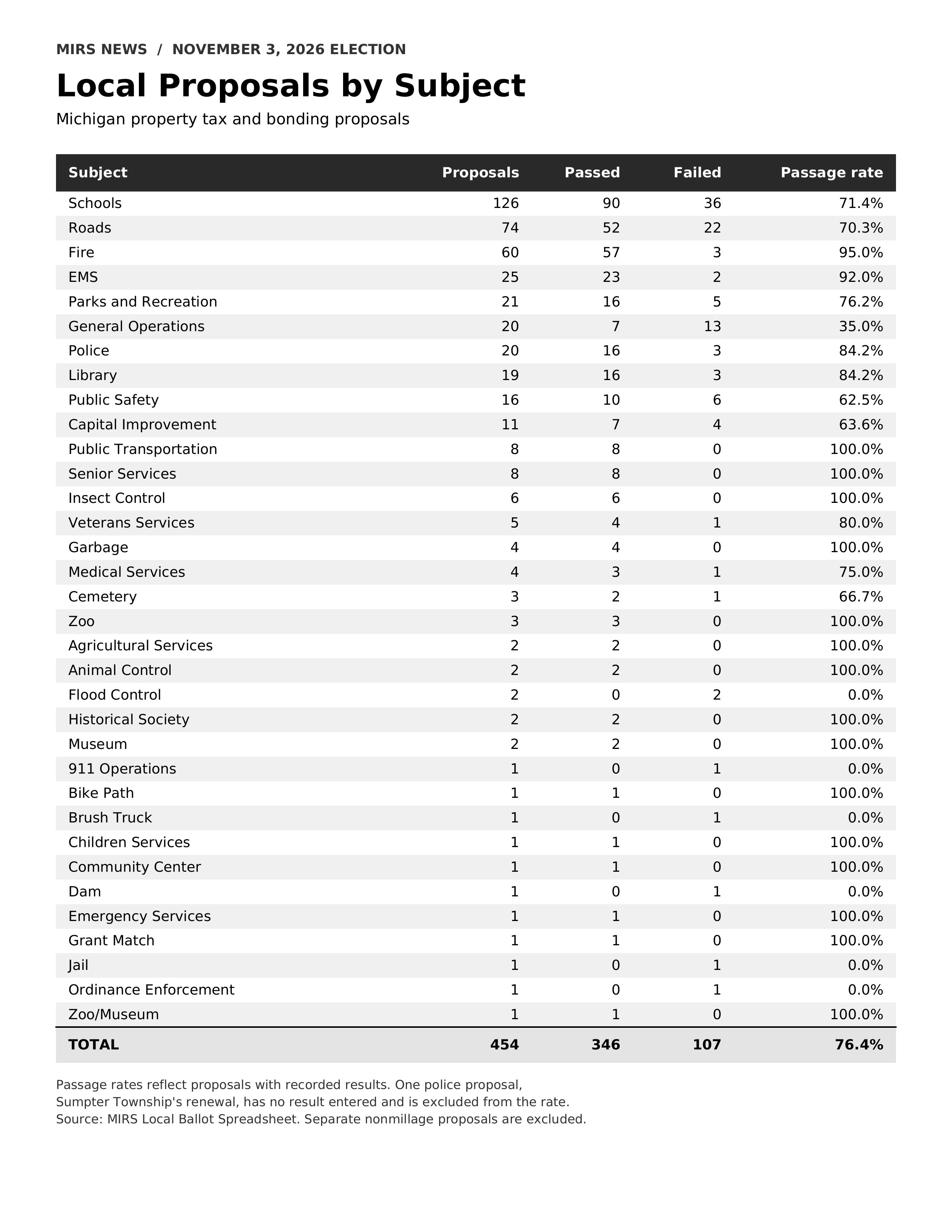
Out of 126 school bonds, voters approved 90 and rejected 36, a passage rate of 71.4%, according to MIRS.
Michigan Capitol Confidential watched eight school districts that asked voters to approve bonds totaling well over $100 million. All of them passed.
Dearborn residents approved a $1.5 billion bond by a vote of 68% to 31%.
Dearborn Public Schools stated on its website that the $1.5 billion bond will not change the total tax rate for its homeowners and will be used to build new schools, improve safety, create STEAM learning spaces, and perform renovations including air conditioning.
“Every student would see improvements within three years,” the district wrote.
Dearborn will not borrow the money at once but will split it into four phases over 15 years. The district asked for $219 million in 2019, but voters denied the bond.
Voters approved a $288 million bond for Chippewa Valley Schools, with 61% in favor and 39% opposed.
The bond spending is broken down into seven categories:
-
Modernize four elementary schools: $92.5 million would rebuild one of the oldest elementary schools and build a new 75,000 square foot building with a total capacity of 600 students and renovate three other elementary schools
-
Facility improvements: $56.4 million would renovate learning support spaces, renovate media centers, improve high school auditoriums, athletic spaces, new signs, and replace playground equipment
-
Update facility infrastructure: $55.5 million would replace roofs, plumbing fixtures, some doors and elevators, lighting, parking lot and sidewalk paving.
-
Replace instructional technology: $40.8 million would replace interactive classroom displays, replace student laptops after five years of use, replace staff devices, and replace and expand the wireless network
-
Improve safety and security: $22.8 million would upgrade the security system to higher resolution, license plate detection, and AI weapons detection. Other spending would create a security operations center, upgrade glass, add emergency generators, and replace fire alarms and outside lighting
-
Replace furniture and equipment: $13 million
-
Purchase replacement buses: $7 million would replace 45 buses to replace buses over 10 years old that have over 100,000 miles.
But the repayment will cost, with interest, $528.6 million.
Some voters took to the Macomb Township community page to express concern over the bond.
“The ballot discloses approximately $323 million in existing qualified bonds and another $33 million in state program loans,” a resident wrote in an Oct. 8 Facebook post. “It also anticipates approximately $31 million in additional state borrowing, with about $21 million in interest on that borrowing alone.”
This resident added that keeping the same tax rate does not make new borrowing free. The request goes beyond roofs and school security to include turf installations, stadium sound and lighting upgrades and other athletic field improvements, he noted, and putting these upgrades in a package with fire alarms and failing roofs “does not give every item the same urgency.”
DeWitt Public Schools approved a $157 million bond that maintains a 10-mill debt tax rate, according to district materials. However, that does not include $53,039,937 in interest that will also need to be paid back.
The bond, touted as being used for facility improvements and upgrades, passed with 5,345 voting in favor and 3,881 in opposition.
The Birmingham Public School District asked its taxpayers for a $240 million bond. The amount is for principal and does not include interest, which will be an additional $173,964,950.
Birmingham schools also noted in a presentation that it identified $470.5 million worth of needs over the course of ten years affecting 18 buildings. The bond passed with 67% supporting it and 33% in opposition to the debt.
Farmington Public Schools passed, with 62% of voters in favor and 38% opposed, a $171 million bond. It identified $390 million in needs, according to the Oakland Journal. That means $0.95 per $1,000 of taxable value the first year and 1.32 mills annually per $1,000 taxable value. Property taxes will go up $95 the first year per $100,000 taxable value and $132 per year after that. As with most of the bond requests in the state, the district noted the money will be spent on infrastructure, athletics, and programs.
Royal Oak Schools asked its taxpayers for $165 million for school renovations, safety improvements, technology, athletic facilities and building additions.
It passed 68% to 32% and will cost homeowners per $100,000 taxable value, $141 for the first year and $205 annually after that.
The district’s bond information includes a comprehensive list of questions and answers, but it does not specify how much interest will be paid on the bond.
Royal Oak noted in its FAQs that “The general fund cannot pay for these large capital investments unless the district makes reductions in other areas of the budget.”
It added that even during times of significant student growth and more robust per-student State funding, the district has relied on support from taxpayer-approved bond issues.
Grand Ledge voted 52.3% in favor and 47.7% in opposition to a $123.5 million bond. For every $100,000 in taxable value, a homeowner will pay $19 the first year and $203 annually after that. A home with a $250,000 taxable home value will pay $507.50 more in taxes annually to cover the bond, which will be used for infrastructure and similar upgrades noted in other district bonds.
The district did not divulge in its frequently asked questions how much interest taxpayers will have to cover.
Lake Orion approved a $115 million bond in a close margin of 51% to 49%. For every $100,000 taxable value of a house, homeowners will pay an additional $174 in taxes the first year and $206 annually after that.
The interest, according to Lady Budgetdown, will make the bond payback total $352.64 million.
Michigan Capitol Confidential is the news source produced by the Mackinac Center for Public Policy. Michigan Capitol Confidential reports with a free-market news perspective.
 Michigan spends record amount on schools, gets worse reading scores
 Michigan school funding tops inflation since before the pandemic
 Granholm, not Republicans, put Detroit Schools under state control in 2009