

Voters consider whether to take on $1.3 billion in new school debt
19 school districts participate in state-sponsored program



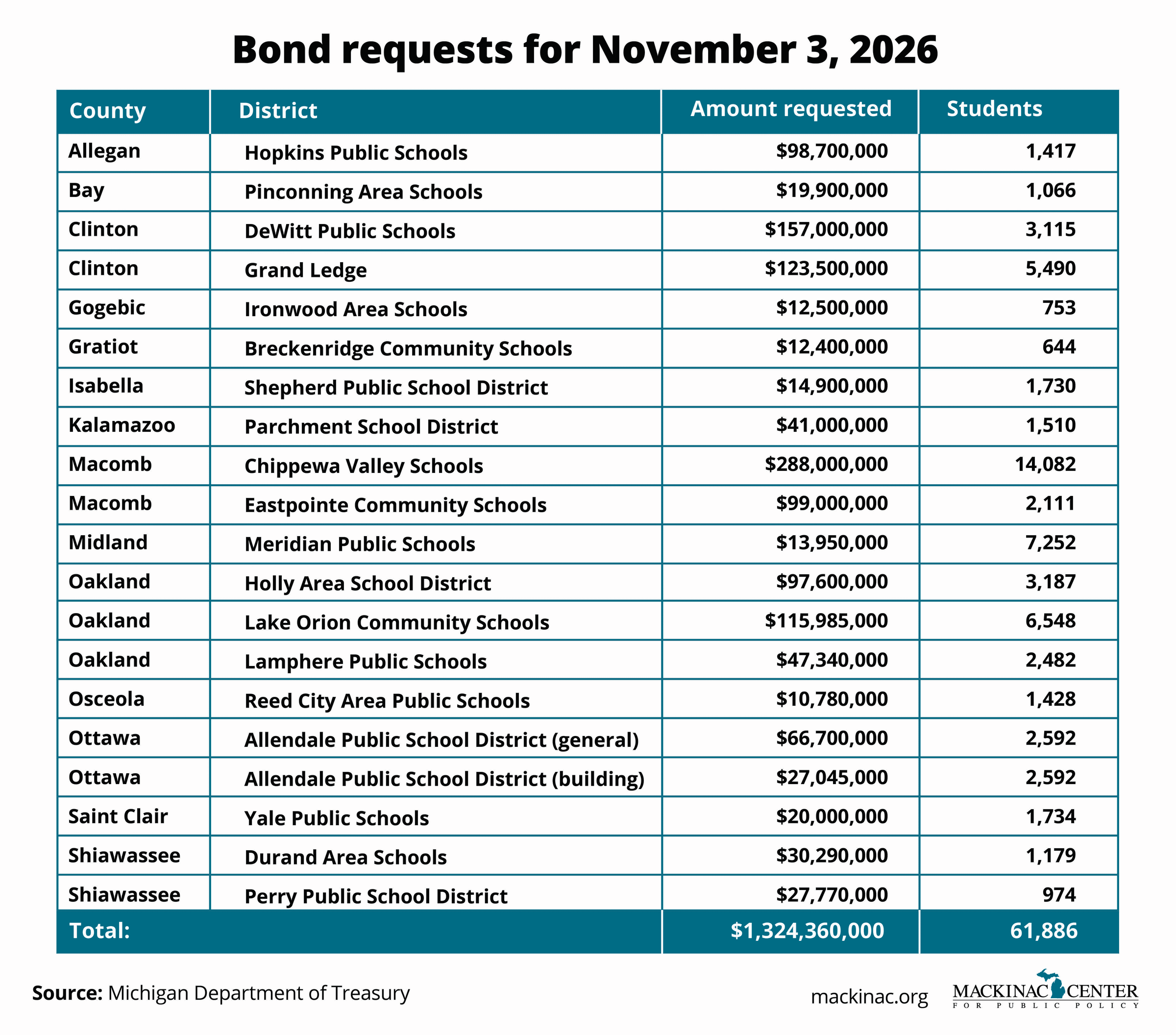
Residents of 19 school districts will determine the fate of $1.3 billion in increased debt for building improvements and other purchases.
The largest debt request comes from Chippewa Valley Schools, which wants to borrow $288 million. DeWitt Public Schools seeks voter permission to issue $157 million in bonded debt, and Grand Ledge Public Schools wants approval to take on $123.5 million in debt.
School districts would spend the new funds on a variety of projects, with each proposal calling for spending on remodeling. Sports facilities would get an upgrade under 10 bond proposals, and safety-related projects would get funding from 10 proposals as well.
Play facilities and information technology would get funding under 11 proposals.
Allendale Public Schools split its request into two proposals, one of which is for a sports and recreation building that would be open to community use. The other 18 districts have only one measure on the ballot.
The Chippewa Valley district would purchase upgraded security cameras, an emergency notification system and backup generators. It would also repair various buildings.
The DeWitt district says it would spend 20% of its bond proceeds on what it calls technology and safety; extracurriculars; and athletics. These categories would include security cameras, safety-related changes to parking lots, renovating a high school auditorium and improving weight rooms, bleachers for a pool and baseball dugouts. Voters approved a bond request in 2021, and $2 million from that remains unspent.
Districts routinely seek voter permission to issue bonds to spread out the cost of purchasing big-ticket items. School bonds have a higher cost than the amount stated on the ballot. Interest payments can add substantially to the cost of a debt, as is the case, for example, with a home mortgage.
Chippewa Valley Schools seeks permission to borrow $288 million, but the total cost over time would be $528.6 million, according to calculations presented on a Facebook page called LadyBudgetdown.
The $1.3 billion total represents the amount districts seek to raise through the School Bond Qualification and Loan Program administered by the Michigan Department of Treasury. The program lets districts obtain lower interest rates by relying on the state’s credit record.
The districts enroll roughly 62,000 students.
Michigan Capitol Confidential is the news source produced by the Mackinac Center for Public Policy. Michigan Capitol Confidential reports with a free-market news perspective.
 Out-of-state dark money bankrolls Michigan ‘Money Out of Politics’ ballot push
 Poll shows Proposal 2 support in Michigan
 Michigan schools seek $1.6 billion in new public debt May 6