


Voters defeat St. Johns school bond for the third time
Voters spiked $40 million bond question


Residents of the St. Johns Public Schools district bucked a statewide trend of school spending increases in this week’s election by turning down a request for new bonds. It was the third no vote in recent years, with participants of social media groups calling the latest proposal a contentious ask.
Voters denied the $40 million bond question with 5,682 no votes, 54% of ballots cast, and 4,828 yes votes, 46% of ballots cast.
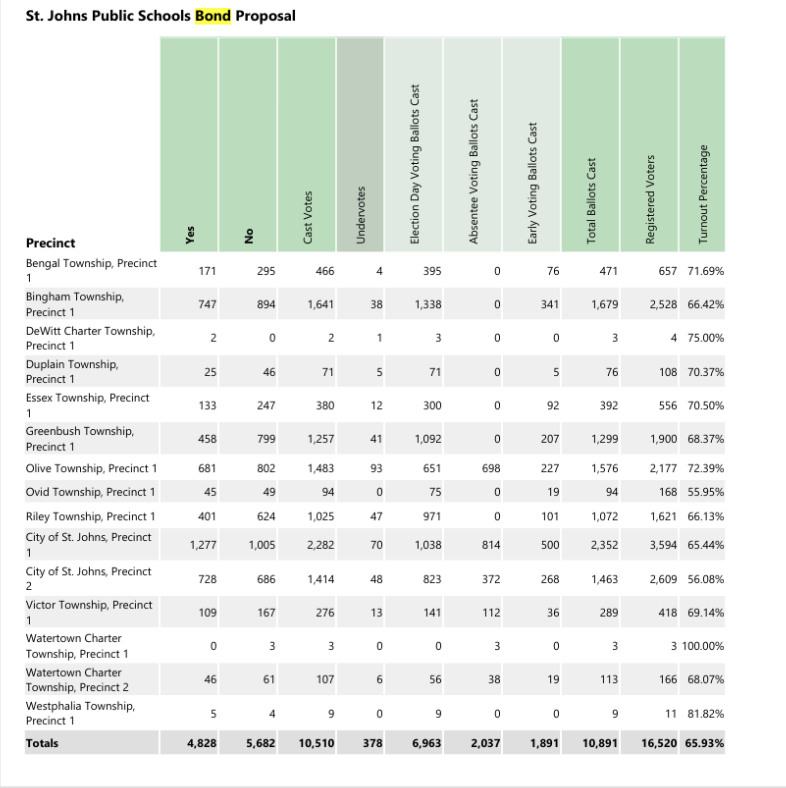 St. Johns Public School election results
District leaders requested a $92 million bond in 2024, but voters rejected it. The total cost, with interest, would have been $178 million.
The district returned to voters in May 2025, asking for $99.7 million in bonds. Voters said no.
The latest proposal was a smaller version of the 2025 request and would have been used for infrastructure improvements, athletics, security, and classroom improvements.
Social media fora were filled with debates over the most recent request.
St. Johns Chronicles, a local news site, hosted at least 20 posts regarding the bond, each drawing dozens of comments from residents.
James Sills, who was just elected to the school board, used a Facebook post to explain why he did not support the bond request.
Sinking funds, Sills wrote, are a school finance mechanism that allows for a continuous interest-free revenue stream for capital improvements. He said he preferred using a sinking fund, which provides for a narrower scope for taxpayer-provided funds and more solidified cost estimates.
Sinking funds are a targeted approach for capital improvements, leave the general budget alone and provide for greater community oversight, he said.
“By 2033, we can create a $4 million dollar YEARLY budget for capital improvements, leaving the general budget to pay for staff salary increases, curriculum, and other day to day operations,” noted Sills.
He provided an example that under a sinking fund a $3 million chiller for an ice rink costs $3 million.
Under a bond, a $3 million chiller would cost nearly $4.5 million.
“Bonds incentivize ALLOWING the necessary maintenance, replacement and upkeep to be held off until a bond passes, then LOCK you in debt for 20-30 years, paying nearly 50% more interest,” Sills wrote.
A current school board member, Scott Darragh, took to social media Oct. 20 to explain that St. Johns schools received a clean audit for fiscal year 2025-26. The district has a solid fund balance, and it no longer borrows for cash flow. For these reasons and others, he said, voters should support the bond.
Michigan Capitol Confidential is the news source produced by the Mackinac Center for Public Policy. Michigan Capitol Confidential reports with a free-market news perspective.
 Voters consider whether to take on $1.3 billion in new school debt
 Michigan schools seek $1.6 billion in new public debt May 6
 Out-of-state dark money bankrolls Michigan ‘Money Out of Politics’ ballot push