


Michigan ranks No. 6 among states for worst record in chronic absenteeism
29% of Michigan students were chronically absent in 2025


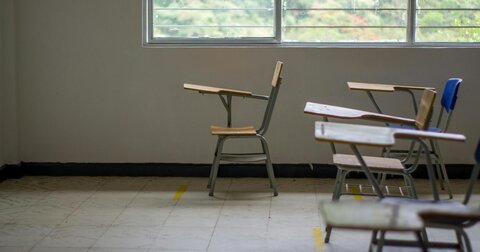
Michigan had the sixth-worst rate among 44 states for the number of students who were chronically absent from school in 2025, according to the new report. Last year, 29% of students in the Great Lakes State were chronically absent.
The American Enterprise Institute report, "From Attendance Crisis to Chronic Condition?,” defines a chronically absent student as one who misses at least 10% of the days in a school year. Officials at the Michigan Department of Education use the same definition.
The report from the Washington, D.C.-based think tank evaluates school systems and states by the percentage of their students who are chronically absent, which amounts to 15 to 20 times per school year.
Nationwide, the chronic absenteeism rate before the COVID-19 pandemic was roughly 15%, according to the report. That calculation, and state-to-state comparisons, omit six states for which the report did not have 2025 data.
Nate Malkus, the report’s author and deputy director of education policy at the institute, omitted the years 2020 and 2021, saying that pandemic-inspired lockdowns and increased focus on remote instruction made data from those years unreliable.
By 2022, the national rate had risen to 28.3%, though it declined to 22.6% last year. The slow rate of bringing attendance back to its pre-pandemic level is ominous, Malkus wrote. It “should be met with urgent action, not ignominious acceptance.”
The rise and fall of chronic absenteeism is found across Michigan school districts.
The Flint Community Schools district reported that 49% of its students were chronically absent in 2019 — a number that soared to 81% in 2022. Absenteeism has slightly decreased since then, dropping to 74% in 2025, according to the Return to Learn Tracker.
Grand Rapids Public Schools reported in 2019 that 27% of its students experienced chronic absenteeism. The absenteeism rate peaked at 54% in 2022, declining to 41% in 2025.
Bloomfield Hills Schools showed that 10% of its students were chronically absent in 2019, a share that more than doubled to 22% in 2022. Chronic absenteeism in the district declined to 15% of students in 2025.
Rural districts were not immune from increased absenteeism. Chronic absenteeism in Reed Area Public Schools stood at 11% in 2019 but more than quadrupled to 44% in 2022. That rate stood at 29% in 2025.
Comparing states to each other, or comparing districts within the same state, is a challenging task, Malkus, the report’s author, told Michigan Capitol Confidential in an interview. That’s because reporting on chronic absenteeism is not uniform.
In some locations, for example, state law defines what constitutes an absence. Other states, however, let districts make that determination. While one district or state may consider a half-day attendance as an absence, another may not. When states or districts use different definitions, that can affect the official absenteeism rate.
Still, the report notes, “within-state changes across time are generally informative.”
Three states and the District of Columbia had a chronic absenteeism rate of more than 30% in 2025: Alaska, New Mexico and Oregon. Alabama had the lowest rate, at 12%.
Michigan, at 29%, did worse in 2025 than Illinois (25%), Ohio (24%), Indiana (18%) and Wisconsin (17%).
School districts that relied on remote instruction the longest time saw the greater increases in absenteeism, Malkus said, though it was not the most important factor. Many districts that didn’t have extended closures also saw big jumps in chronic student absences.
A key driver of increased absenteeism, Malkus found, was the share of students who were classified as disadvantaged.
Districts that had a large number of minority students or lived in poverty had a higher rate of absence. So did districts with low standardized test scores.
The school district in the affluent Michigan city of Northville, for example, had a chronic absenteeism rate of 7% in 2019. Its rate increased to 17% in 2022 but declined to 13% by 2025.
In Benton Harbor, with a substantially higher number of disadvantaged students, 56% of students fell into that category in 2019. That rate peaked at 75% in 2022 and was reported to be 68% in 2025.
The report did not have 2025 data for six states: Arizona, Minnesota, Montana, New Hampshire, Texas and Wyoming.
Michigan Capitol Confidential is the news source produced by the Mackinac Center for Public Policy. Michigan Capitol Confidential reports with a free-market news perspective.