


New report shows Democratic-led states have substantially higher gas prices
State taxes, fees, special requirements drive up costs


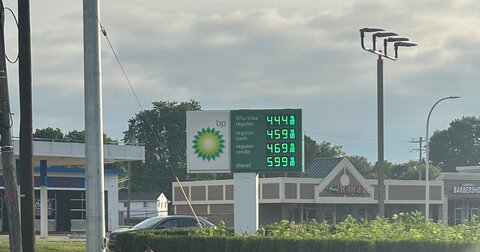
States governed by a Democratic Party trifecta — in which members of that party control the governor’s office and both chambers of the Legislature — have gas prices that are on average 55 cents per gallon higher than those of states with a Republican Party trifecta, according to a new report published by the Institute for Energy Research.
Michigan has the second-highest gas taxes in the nation after California, according to Alex Stevens, manager of policy and communications at the institute.
The explanation lies in Michigan’s combination of the excise tax, fees, and surcharges required on gasoline and diesel sales, Stevens told Michigan Capitol Confidential in a phone interview.
Michigan’s gas tax is 53.4 cents per gallon when surcharges are included, said Stevens, who contrasted that total with the national average of 33.5 cents per gallon.
As a result, the average Michigan driver with a 14-gallon tank pays $108.41 more in gas tax per year than the national average.
GasBuddy, Stevens said, reported that gas prices in Michigan were around $3.95 per gallon on July 15. The national average on that day was $3.84. The average price in Indiana was $3.25 per gallon.
Michigan was a Democratic-trifecta state in 2023-24, and it has had a Democratic governor since 2019.
Gov. Gretchen Whitmer and Attorney General Dana Nessel have tried to shut down the Line 5 pipeline that traverses the Straits of Mackinac. Stevens said that shutting down the pipeline would affect gas prices in the state. The only refinery in Michigan is based in Detroit, and the oil for it comes from Line 5.
Geography plays a role in gas prices, Stevens said. California, Washington, Oregon, and Hawaii tend to have higher prices due to their location. The West Coast has isolated refining, uses special blends and has no pipeline connection to the Gulf Coast.
Stevens said that policy choices make a difference, too. He cited in particular the cap-and-trade programs in Washington and California, which regulate the market in the name of lowering greenhouse gas emissions.
Gas prices in Washington rose between 48 and 58 cents per gallon after the state adopted that program, the institute report says. The “West Coast premium was modest from 2017 through 2021, ranging from $0.20 to $0.44 per gallon,” the report says. “It roughly doubled to $0.67 in 2022 and climbed to $0.91 by 2026.”
California’s approach to refining played a role, Stevens said. Phillips 66 and Valero facilities have permanently shut down, Stevens noted.
California’s requirements that retailers sell specific blends of fuel increase prices, too, Stevens said. The state needs refining capacity because no other jurisdiction imposes the same requirements, putting another layer of financial strain on petroleum companies, and in turn gasoline prices.
Michigan Capitol Confidential is the news source produced by the Mackinac Center for Public Policy. Michigan Capitol Confidential reports with a free-market news perspective.
 State awards $6.3 million study on mileage tax
.jpg) Federal judge rebukes Whitmer, Nessel’s bid to close Line 5
Federal judge rebukes Whitmer, Nessel’s bid to close Line 5
 Whitmer’s energy emergency order stretches her authority