


MEA makes unsupported claims about school funding, student performance
Claim in union president’s op-ed does not match data


A recent article from a major teachers union used a highly selective reading of spending data to argue for more public money and obscure the relationship between spending and student success.
“In inflation-adjusted dollars, Michigan actually spends less per pupil than we did in 2002, and that has — unsurprisingly — contributed to lower student achievement on standardized tests,” Michigan Education Association President Chandra Madafferi wrote in an April 1 Detroit News op-ed.
Madaferri pointed to a Michigan State University report that included school funding information from the state’s 1014 bulletin. That bulletin relies on self-reporting by districts and does not report on total school funding, only general fund revenue and expenses. The 1014 shows that schools received $15,208 per student from general fund revenue, on average, in 2023.
But when revenue from all federal, state and local sources is included, Michigan schools receive $23,867 per pupil, on average. The national average for all schools from all revenue sources is $16,526 per student, according to the Education Data Initiative.
Madaferri did not respond to requests for comment. In 2004, the most recent year for which reliable figures are available, per pupil spending in Michigan was $10,664, which comes to $19,013.99 in current dollars.
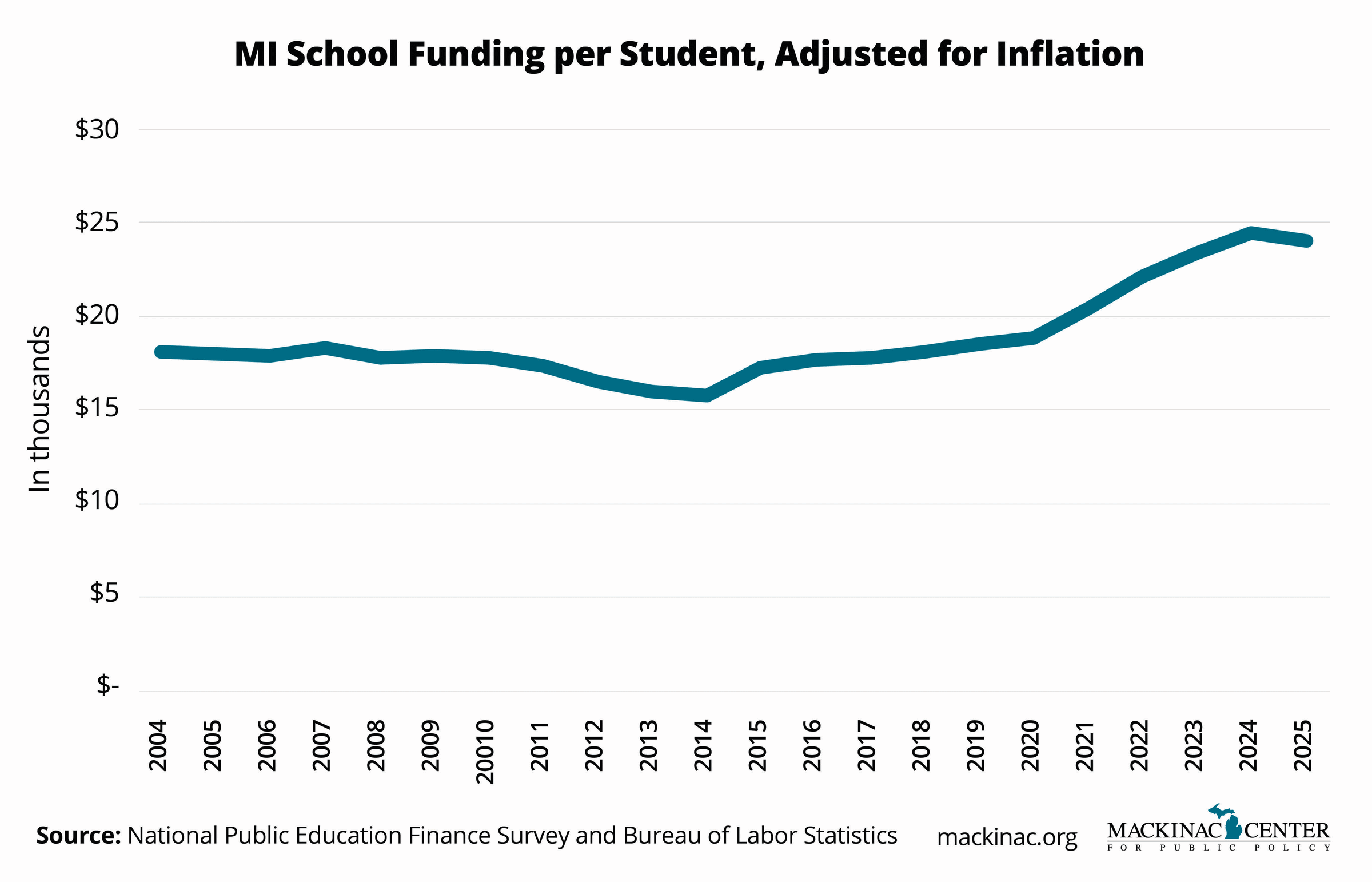
Madaferri’s claim is also at odds with recent comments from both the Michigan Department of Education and Gov. Gretchen Whitmer. The education department in 2023 reported that the per pupil allowance was “the highest in the state’s school funding history.”
Whitmer in 2022 issued a press release highlighting “record investments in every student and classroom.” In her two most recent State of the State addresses, Whitmer lamented the state’s academic performance, saying, “We spend more, and we get less.”
Madafferi also makes assumptions about the relationship between public school spending and academic outcomes.
“It seems like common sense, but it bears repeating: Numerous studies show that investing in our preK-12 schools results in better student outcomes — everything from test scores and graduation rates to future educational attainment and wages,” the union president said.
But Michigan is one of many states where higher spending has not translated into better academic outcomes.
“State spending on K-12 schools has grown nearly 35% over the past decade,” said Molly Macek, education policy director at the Mackinac Center for Public Policy. Yet student achievement in reading and math has declined over the same period, she said.
The way districts spend taxpayer dollars is more important than total funding, Macek added.
“When families can access a quality education and schools are held accountable for their performance, student learning improves,” said Macek.
Increased per pupil funding does not automatically boost academic achievement, the Mackinac Center concluded in a 2016 study.
The National Assessment of Educational Progress reported in 2024 that Michigan ranked 47th among the states for the share of fourth-grade students who score proficient or better in reading. That low ranking followed ten years of consistently increasing per pupil funding.
By contrast, Mississippi has achieved a dramatic turnaround in literacy while spending well below the national average per student.
The Magnolia State was ranked 50th in 2013 for the share of fourth-grade students who read proficiently. By 2024, it outperformed the average and bested 28 states, including Michigan. In Mississippi and eight other states, 32% of fourth-grade students scored proficient in reading. In Michigan, that number was 25%.
Mississippi now ranks first nationally for reading and math gains since 2013.
Per pupil spending in Mississippi is just $14,418 per pupil, according to the Education Data Initiative.
Michigan Capitol Confidential is the news source produced by the Mackinac Center for Public Policy. Michigan Capitol Confidential reports with a free-market news perspective.
 Number of public-school employees reaches 18-year high
 Michigan spends $6.9M advertising 'cost-free' pre-K
 Whitmer undecided on federal scholarship program for K-12 students