

Free speech policies: stronger than ever on university campuses, advocacy group says
Share of ‘red light’ institutions declined from 69% to 13% over 20 years


University-level support for First Amendment expressions of free speech has reached a 20-year high, according to an advocacy group that tracks such matters.
A recent report, Spotlight on Speech Codes 2026, evaluates institutions by their written policies on free expression. The report from the Foundation for Individual Rights and Expression, or FIRE, is the latest edition for the organization that has tracked universities’ speech policies since 2006.
Universities have improved their policies on free speech over the last 20 years, FIRE says. In 2006, more than two-thirds of all universities studied — 68.6% — merited a red-light rating on FIRE’s red-yellow-green standard. The number of red lights, which are given to institutions with policies least favorable to free expression, is at an all-time low, applying to only 13.2% of colleges and universities examined.
The number of green-light universities has increased significantly over 20 years, going from eight in 2006 to 76 in the most recent report.
Most institutions – 69.4% — receive a yellow-light rating, however. These institutions are not the worst in how they treat speech, but their policies still restrict constitutionally protected speech. The yellow rating sometimes refers to ambiguous policies that could be interpreted restrictively according to a subjective standard, said Tim Penning, a professor of communications at Grand Valley State University. Penning, who serves on the Mackinac Center Board of Scholars, spoke to Michigan Capitol Confidential via email.
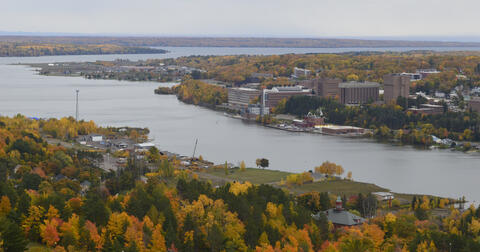
Most public universities in Michigan are in the yellow category, but the two state universities in the Upper Peninsula are exceptions. Michigan Technological University received a green light for its policies, while Lake Superior State University received a red light.
All 15 state universities, including Michigan Tech, were dinged in the ratings for one or more items in the category “Harassment Policies.”
Lake Superior State University automatically earned a red light for keeping its student handbook behind a password wall. FIRE says this “denies prospective students and their parents the ability to weigh this crucial information.”
FIRE surveys 493 colleges and universities — 379 were four-year public institutions, with the balance being private ones — each year.
“Far too many colleges across the country still fail to live up to their free speech obligations in policy and practice,” according to FIRE.
The year with the greatest number of red-light schools — 270 — was 2009, long before 2020, 2021 or 2022, which scholars dub the time of “peak wokeness.”
Though the FIRE report said that legislation was one factor in making policies more favorable toward free speech in recent years, it did not endorse all actions. “Some of these actions have been positive; many have been negative; FIRE has worked to call balls and strikes throughout.”
Here are the state institutions, listed by category and with links to a FIRE evaluation.
Green light (best)
Yellow light (middle)
Red light (worst)
FIRE gives credit to institutions that adopt various policies, including those included in what is commonly known as the Kalven Report, produced by the University of Chicago in 1967. It calls on universities to adopt a stance of neutrality on major social or political issues of the day. As Robert P. George summarized the report two decades later, the university “should take no position on issues of public policy on which members of the community can and do disagree, but should rather provide an impartial forum for the debate and discussion of those ideas without the university’s thumb on the table.”
Three public universities in Michigan have adopted Kalven-like policies: Michigan State University, the University of Michigan and Western Michigan University. Penning, the GVSU professor, applauds their decisions.
Universities, he told CapCon, are under pressure to take stands on specific social issues. “However,” Penning wrote, “their mission as institutions of higher education is to promote exploration, tolerance, and a broad or liberal education. Insisting on one view, or having a code that restricts alternative views, is antithetical to higher education’s stated purpose.”
Some experts who write on free speech criticize FIRE’s rankings. “The flaw in the rankings lies in their failure to account for the central role of disruptive, nonviolent protest in the development of free-speech doctrine and a concomitant abandonment of bedrock First Amendment tenets,” Charles F. Walker, a retired partner of the law firm Skadden, Arps, Slate, Meagher & Flom, wrote in the Oct. 31, 2025, edition of the Chronicle of Higher Education. “FIRE's model of proper protest,” Walker wrote, “is more akin to a polite debating exercise.” The point of a political protest, he continued, is to be disruptive. The act of pressuring administrators into cancelling a scheduled event “is protected speech,” he concluded, as is heckling at public events, two activities for which FIRE consistently downgrades universities.
Michigan Capitol Confidential is the news source produced by the Mackinac Center for Public Policy. Michigan Capitol Confidential reports with a free-market news perspective.
 Michigan cities fight residents over free speech
 Out-of-State dark money bankrolls Michigan ‘Money Out of Politics’ ballot push