

Michigan Legislature avoided corporate handouts in 2025
State approved no new select business subsidy programs amid steep slide in demand for electric vehicles



The Michigan Legislature approved no new select business subsidies in 2025.
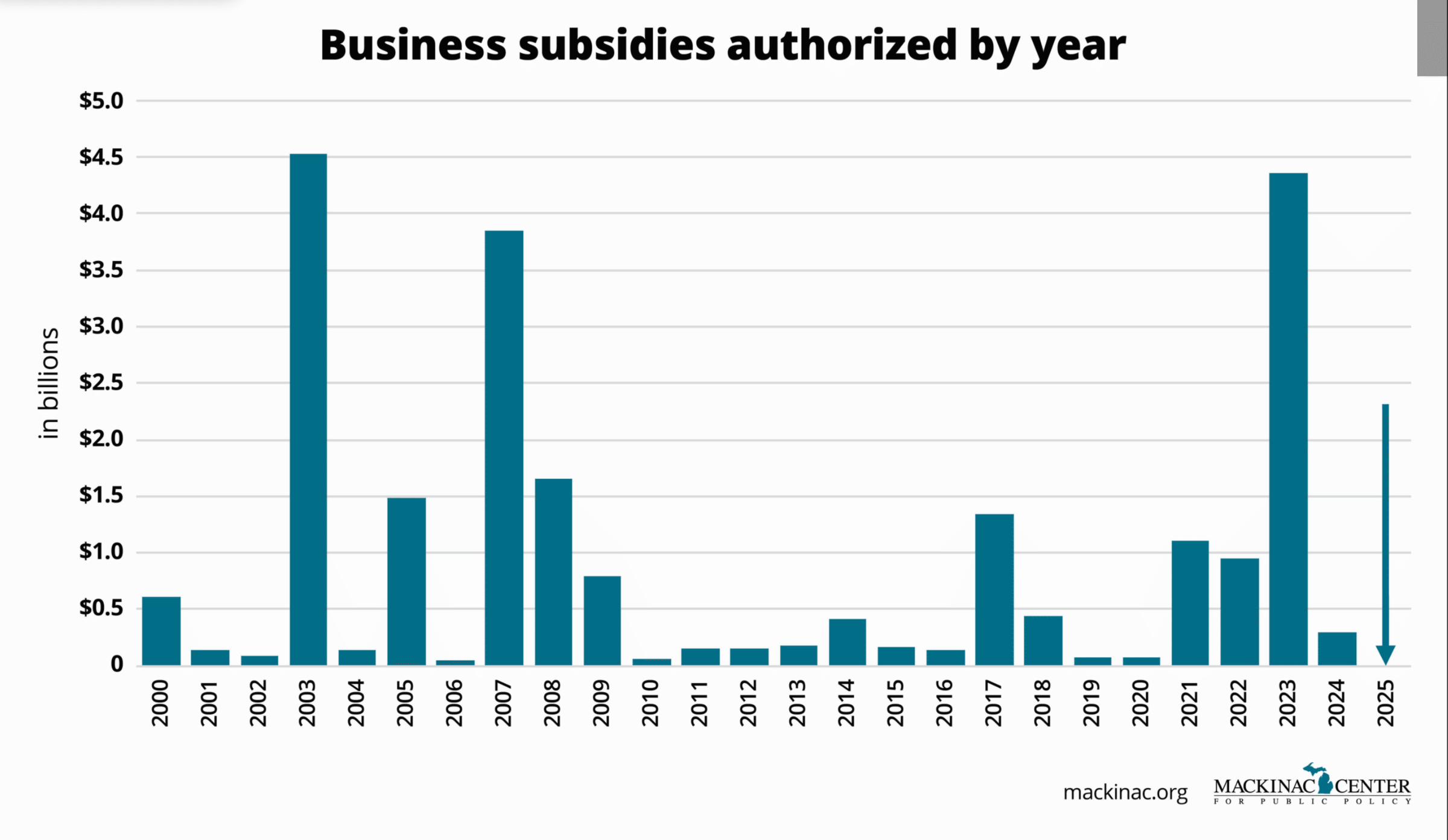
That was a major contrast with recent years. Lawmakers have approved $23.2 billion in business subsidies since 2000, an average of $930 million per year, according to James Hohman, the director of fiscal policy at the Mackinac Center for Public Policy.
This total includes money for developers, filmmakers, battery manufacturers, “green energy” projects and other handpicked businesses.
Hohman welcomed the change.
“There has been a consistent political demand to take money from taxpayers and give it to select businesses,” Hohman told Michigan Capitol Confidential in an email. “The lack of new subsidies this year expresses a growing skepticism on both sides of the aisle about the effectiveness of corporate welfare. And the state is better off without it.”
Lawmakers also torpedoed the Strategic Outreach Attraction Reserve Fund. The state spent $720 million on the program, which has yet to create new jobs. Some of the companies that received money are:
-
Detroit Diesel Corporation, $27.7 million
-
Solar Technology LLC, $68 million
-
Dow Inc., $120 million
-
Ultium Cells LLC, $120 million
-
Gotion Inc., $125 million
-
Ford Motor Co., $100.8 million and $210 million
-
Our Next Energy Inc., $200 million
-
General Motors Co., $480 million
General Motors received $480 million to redo its Orion Township assembly plant to build full-size electric-powered pickups. The plant will produce the GMC Sierra Denali EV and the Chevrolet Silverado EV, according to GM’s website.
The firm Our Next Energy, which was founded in 2020, received more than $70 million. In 2023, it laid off 25% of its employees, CapCon reported.
Despite this spotty record, Michigan Economic Development Corp. CEO Quentin Messer said in a Nov. 12 Gongwer News Service interview that the SOAR fund didn’t fail.
Messer told Gongwer that the fund did what it was intended to do: “get us into the consideration set, improve the portfolio of development-ready sites across the state and secure investment from large, advanced manufacturers who have significant ’CapEx,’ capital and investment needs.”
A 2024 report by the Mackinac Center found that between 2000 and 2020, only 9% of the jobs promised through official subsidy programs materialized.
Michigan Capitol Confidential is the news source produced by the Mackinac Center for Public Policy. Michigan Capitol Confidential reports with a free-market news perspective.
 Incoming House speaker wants $2.8B shift to fix local roads
 McDonald Rivet voices doubts about effectiveness of corporate welfare
 Michigan spent $1.8B on corporate welfare, got 3% of promised jobs