


Michigan panel weighs data center boom
The Mackinac Center hosted a forum to tackle the costs and benefits of data centers in Michigan


More than 3,000 data centers exist in the U.S., according to an April 13 report from Pew Research, with another 1,500 in development. Their growth has brought much public debate in Michigan about the trade-offs involved, as data centers flock here.
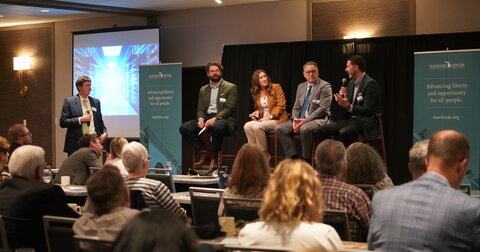
Given that backdrop, the Mackinac Center for Public Policy hosted a forum April 22 to examine the benefits and costs of expanding data centers. Panelists addressed the economic benefits of data centers, as well as concerns about their electricity use, water use, and the limits of local control.
The event, moderated by Jarrett Skorup, vice president of marketing and communications at the Mackinac Center, featured Will Rinehart, senior fellow at the American Enterprise Institute, and Tyler Marie Theile, vice president and chief operating officer of the Anderson Economic Group. It also included Dustin Walsh, senior reporter for Crain’s Detroit Business, and Stephen W. Mackey, senior vice president for finance and administration at Oakland University.
Even small data centers can provide significant economic benefits, Theile told panelists.
A data center facility employing about 25 full-time workers can generate roughly $1 million in annual payroll for local households. It can mean more than $1.1 million in annual tax revenue for a typical Michigan municipality, she noted.
About a dozen of those jobs would be new to the community, Theile said, citing economic modeling. Another 111 indirect jobs would be supported through spending and related activity, she said.
The total impact can be substantial, Theile added.
A single large data center, she said, can generate economic activity comparable to hosting two Detroit Lions playoff games each year, Theile said.
Data centers could bring between $121 million and $5.5 billion in net new economic output to Michigan, according to Theile.
Automotive manufacturing, medical services and insurance — all central to the state’s economy — rely on data center infrastructure to operate, she added.
Skorup asked the panel why data centers are necessary.
“Do y’all have a phone in your pocket today?” Thiele replied. ”You’re using data centers. If you have a home computer, you’re using data centers. If you have health insurance, you’re using a data center.”
The growth of data centers in Michigan is the result of a “perfect storm,” Walsh told the panel. Factors include incentives, declining manufacturing and utilities that need to invest in aging infrastructure.
The imperative to maintain and upgrade infrastructure is one reason why companies that develop data centers focus on smaller communities, Walsh said.
Large technology companies are willing to spend tens of billions of dollars on facilities and equipment, creating strong incentives for both utilities and local governments, Walsh added.
Residents in some communities oppose new data centers, Walsh conceded, with their objections driven largely by concerns over water consumption and rising energy costs.
Developers find low-population townships attractive, Walsh said, because they have buildable land, zoning codes that allow for data centers, and nearby electrical substations.
“They picked these smaller townships because of their availability,” Walsh said, adding that many projects are driven by developers who want to unload properties they’ve held for a long time.
Township officials who want to prevent a data center from opening are likely stuck. Even if a local board wanted to reject a data center, current law keeps it from doing that.
“Township boards actually have no choice but to approve these,” Walsh said, noting that ordinances were written long before modern large-scale data centers existed. Communities that attempt to block projects risk legal challenges, he added.
Walsh cited Lyon Township in Oakland County as an example.
Anthropic, a leading company in artificial intelligence, is eyeing the township for a data center.
The township approved data centers in 1992. “They were a far cry from what Anthropic’s data center is going to be,” he said.
Nobody could have predicted the growth of data centers or the shape they have taken, Walsh said.
The panel also discussed the environmental and energy effects that data centers will have on surrounding areas.
Environmental concerns, particularly around water usage, are complex but manageable, Rinehart said.
He noted that newer facilities are increasingly using closed-loop cooling systems to reduce water consumption, adding that large data centers still operate at an industrial scale.
“There’s a lot of ways to do this smart,” said Rinehart. Thoughtful planning, he added, can address many concerns without imposing bans.
Data centers require a large amount of electricity, a major concern for some.
Panelists noted that utilities such as DTE Energy and Consumers Energy are not allowed under state law to raise rates specifically because of data centers.
Still, Walsh said, the scale of investment in data centers and their demand for electricity could contribute to rising costs.
Residents who already face higher energy prices, driven in part by inflation, worry that additional demand from data centers could push their costs even higher, Mackey said.
“The question is how do we ensure that in the future that as, as these new sources, and of demand, come online that we can do it intelligently so that consumers don't have to bear that that burden,” Mackey continued.
Michigan Capitol Confidential is the news source produced by the Mackinac Center for Public Policy. Michigan Capitol Confidential reports with a free-market news perspective.
 Coal’s comeback: Report says old plants could power AI boom
 Legislature extends tax breaks for data center that brought only 2.6% of promised jobs
 State probes July power failures