


Republicans introduce bills to change state energy laws
Legislation would repeal clean energy mandates, require utilities to focus on reliability


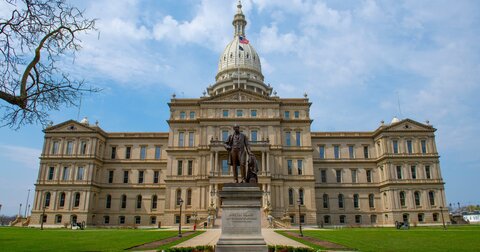
As Michigan faces higher energy costs and looming climate mandates, the state House is considering bills that its sponsors say will give consumers and businesses relief from high utility bills.
House Bills 5710 and 5711 would reduce requirements utilities face related to environmental justice, renewable energy, and funding consumer advocacy. The so-called Project Lighthouse bills would also require Michigan utilities to give priority to reliability, affordability, and minimizing costs.
Rep. Pauline Wendzel, R-Watervliet, called current state energy policy a “green energy scam” in an email to Michigan Capitol Confidential.
“Michigan families have been treated like ATMs for a broken system,” said Wendzel, who chairs the House Energy Committee and introduced the bills with 39 co-sponsors. Wendzel took aim at the state’s 2023 energy law, which mandates that utility companies transition to 100% carbon-free energy sources by 2040. Michiganders, she said, are paying for carbon mandates and an energy grid that relies too heavily on weather-dependent power sources such as wind and solar power.
Wendzel said the bills would restructure state energy policy. They follow legislation, passed by the House last year, aimed at reforming energy policy in Michgan.
House Bills 4027 and 4028 would restore local control over large-scale wind, solar and battery projects, said Wendzel. Those bills passed the House on a party-line vote in April 2025 and await Senate consideration.
The impending energy mandates are getting tighter scrutiny after state regulators approved a $276.6 million rate increase for Consumers Energy March 27.
The Republican plan calls for freezing utility rates for at least two years, House Speaker Matt Hall, R-Richland Township, told CapCon in an email. “Once again, the (Michigan Public Service Commission) has approved another painful rate hike for customers at a time when Michigan families and small businesses are already struggling to keep up.”
Hall said the legislation would “force utilities to cut rates by $1 billion, wiping out these increases from the past three years.”
Consumers Energy and DTE Energy, the state’s two large regulated monopolies, were noncommittal.
“We will review any proposed legislation once it is formally introduced and remain committed to working with policymakers, regulators, and stakeholders to help ensure Michiganders have access to safe, reliable, and affordable energy today and in the future,” said Trisha Bloembergen, a spokesperson for Consumers Energy.
DTE Energy said it is reviewing the legislation.
“As with any proposal, we’ll take the time to fully understand the potential impacts on our customers, our operations and Michigan’s energy system,” said Jill M. Wilmot, director of corporate communications at DTE Energy. We will work with policymakers and regulators in the legislative process, she added.
The Michigan Public Service Commission declined to comment.
A Michigan energy expert said the bills address the state’s need for affordable reliable electricity power.
“Past regulations have mandated the use of weather dependent wind and solar power,” said Mackinac Center Director of Energy and Environmental Policy Dave Stevenson. “Since 2019, residential electricity rates have increased $365 a year, with most of that due to expensive wind and solar projects. Our research shows rates could increase another $2,000 a year by 2035 if we continue down this path, and we will likely face blackouts. The proposed Project Lighthouse legislation ends the wind and solar mandates and open the door for better energy policy.”
Michigan Capitol Confidential is the news source produced by the Mackinac Center for Public Policy. Michigan Capitol Confidential reports with a free-market news perspective.
 State probes July power failures
 U.P. leads Michigan in emissions cuts, faces spike in energy costs
 Whitmer boasts of Michigan’s energy prices, which are high for its region